SJCI Reflections is a collection of memories and stories shared by alumni. These pieces highlight moments, friendships, and experiences from school days that continue to stand out years later.
New reflections are added over time, with the most recent appearing at the top of the page.
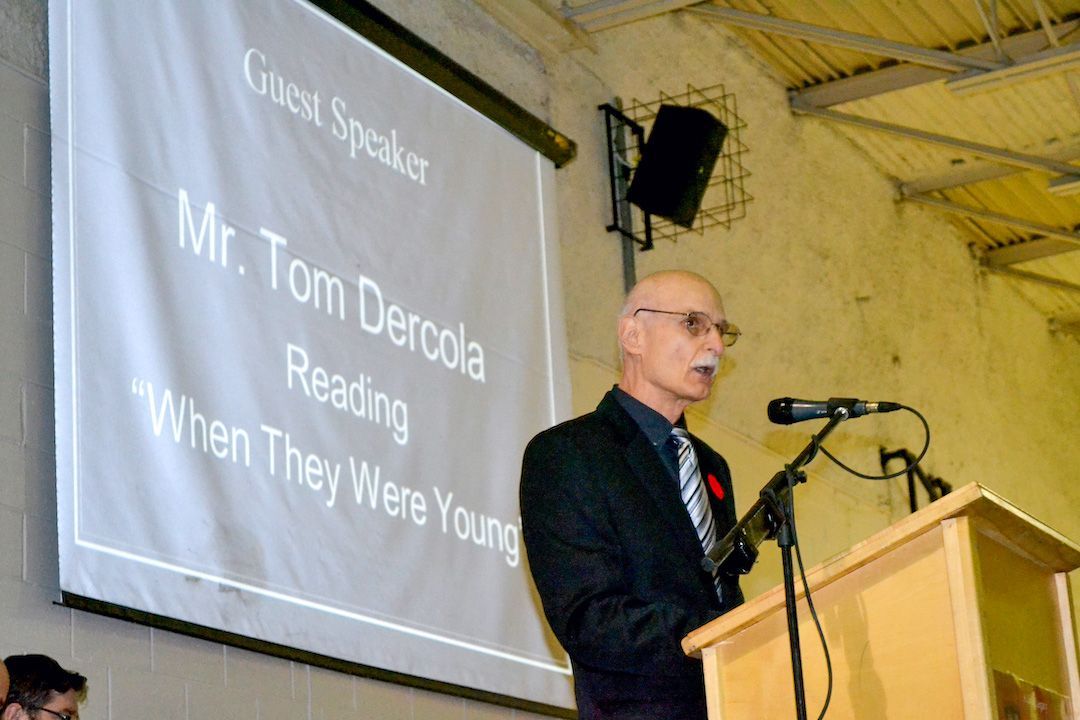
And thanks to Tom Dercola for his Reflections, hard work and dedication for his memories as a long time educator at SJCI.
Mr. Kaleta: Across Four Decades
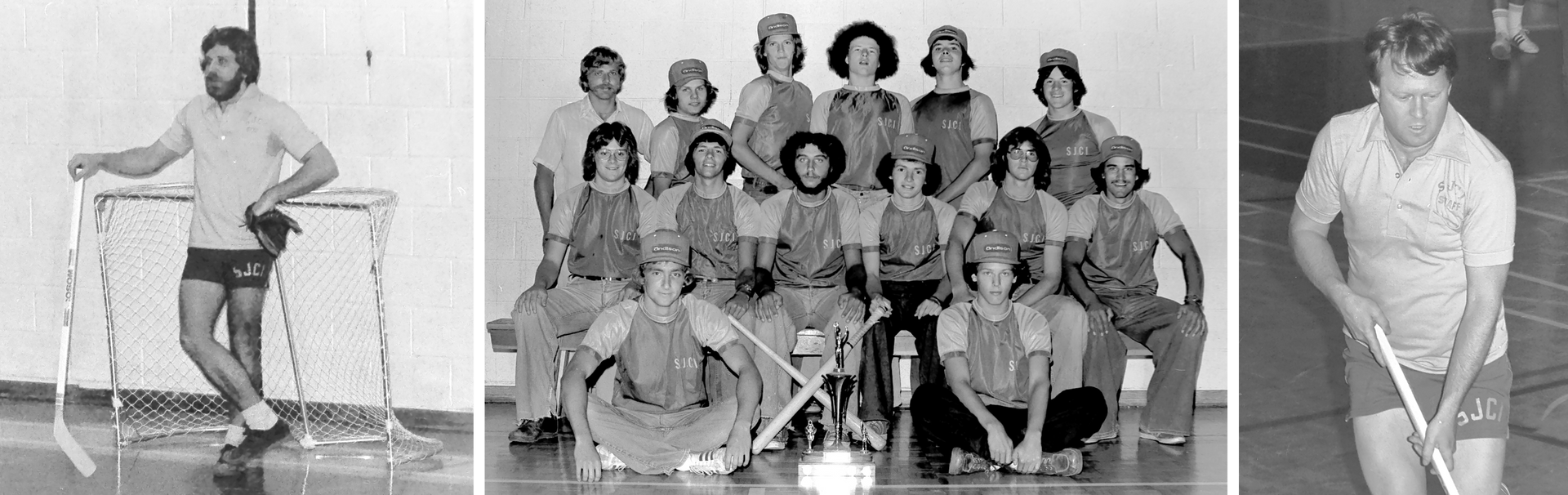
Mr. “Cleats”’ Kaleta played a prominent role at SJCI from 1975-2004. In addition to his role with the Business Ed Department, he coached many winning teams and was an active participant on our staff teams.
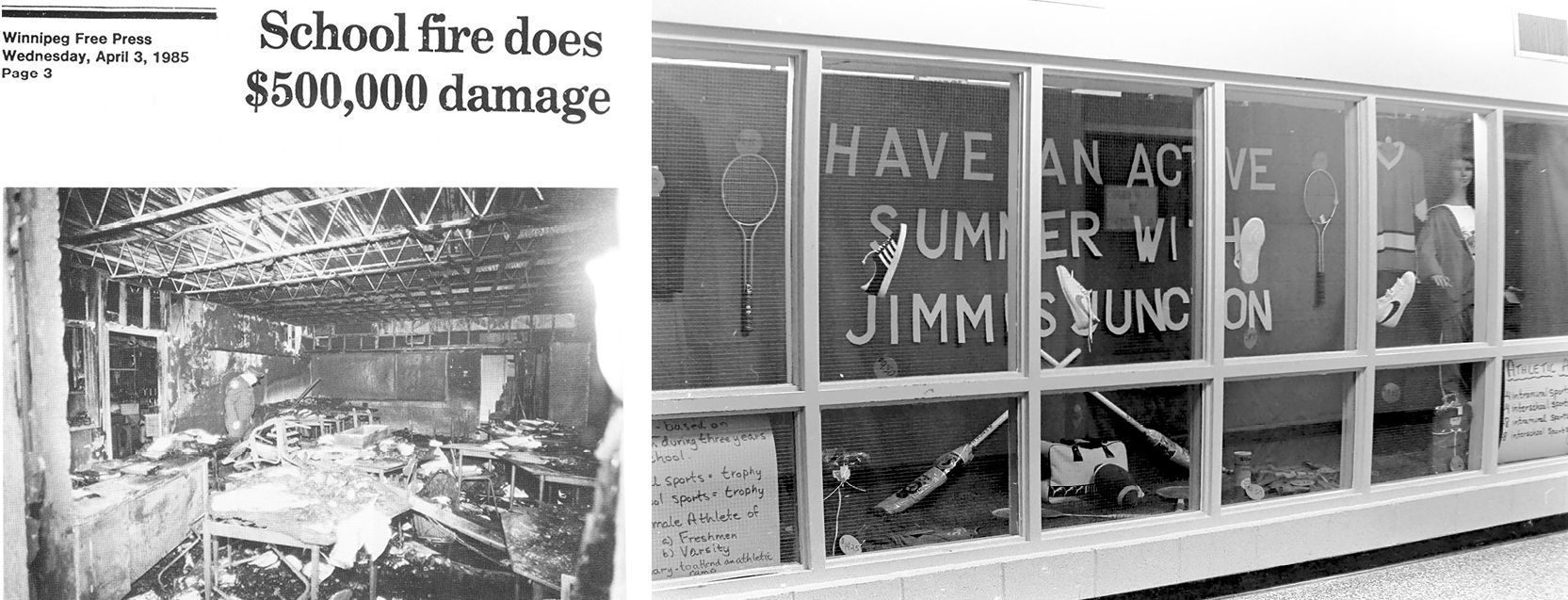
After the Great Fire of ’85, he inherited a larger classroom which included Jimmies’ Junction. It was the go to place for students looking for chocolate bars, snacks and various classroom necessities. He also oversaw, the Caf and was instrumental in getting Skip Scott and his family to operate it and after Skip, Sheila Clark.
He coached many winning teams over the years, especially in baseball / fastball. His Girls’ team won the 1979 SJAAC Championship and in 1983, his Girls’ team captured the Provincial Championship. Now working with Mr. Warkentin (1982-1995), their Boys’ team were Division Champions and they repeated the next year.
“Cleats” was instrumental In fostering school pride with orders of school uniforms and no more so than uniforms for the teacher’s intermural teams. And the he was a fierce competitor for the various staff teams.
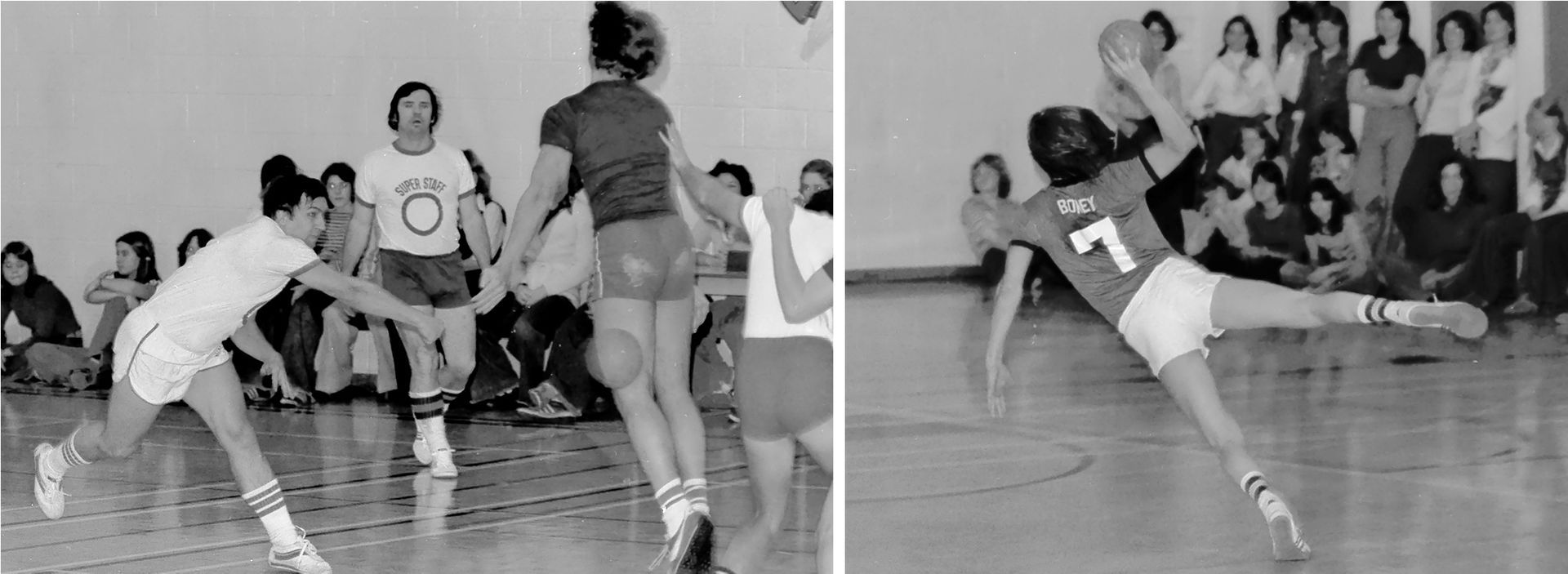
In the photos, you will see “Cleats’ in the net for the teachers in an intermural game and Mr. Mochnacz (1969-1979)‘modelling’ one of the teacher uniforms.
We Were There (Part 2)
1985: SJCI hit by fire; classes move to shuttered Deer Lodge Junior High
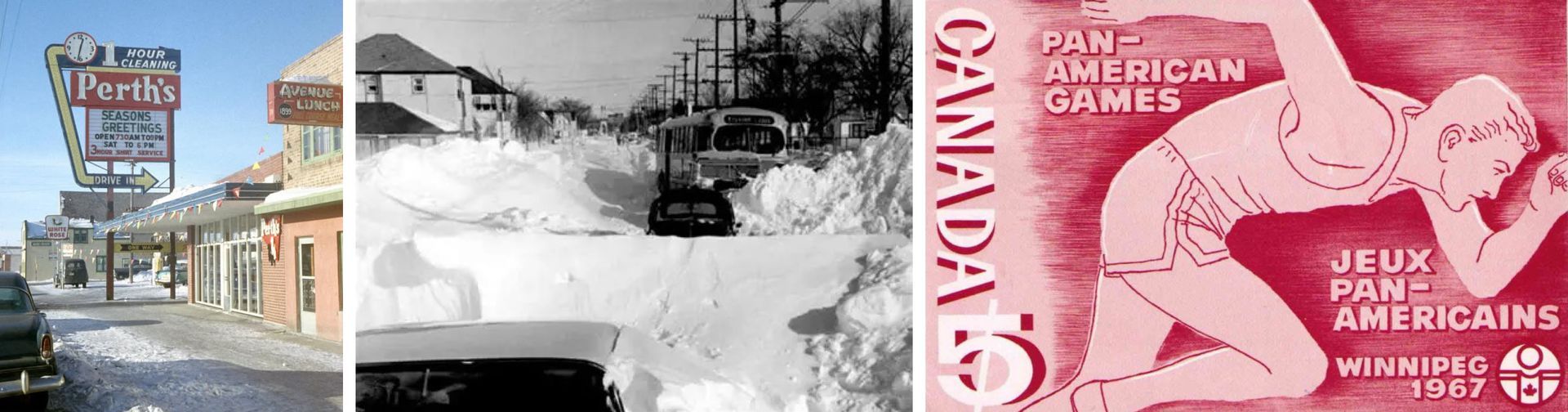
1986: Winnipeg hit by blizzard (56.2 cm)
1991: GST introduced on Goods and Services
1992: Susan Thompson, SJCI Alumna, became the first female Winnipeg mayor
1992: Headingly is incorporated as separate municipality.
1996: Jets 1.0 depart Winnipeg
1996: SJCI created the first student-operated credit union via Astra Credit Union
1997: Winnipeg hit by blizzard (48 cm), part of winter dump of 156+ cm leading to… the Flood of the Century which threatened southern Manitoba
1997: SJCI uplinks to the world via satellite Rick Hansen's 10th Anniversary Tour Presentation
1997: George Waters Middle School created
1997: Ian Ross, Alumnus, received the Governor General's Award for English Drama, making Ross the first First Nations person to win the award
1998: SJCI won an Addictions Awareness Award for our campaign against Teens Drinking and Driving
1998/99: Winnipeg hosts the World Junior Hockey Championships.
1999: Winnipeg hosts the Pan Am Games (again!)
1999: Y2K Scare-fear of global computer failures due to a two-digit year coding system
2001: SJCI celebrated 50 years
2001: 9 /11 Attack on New York; we watch it live in our classrooms
2011: Winnipeg Jets 2.0 return to Winnipeg with the opening of the MTS Center
2017: Winnipeg hosts the Canada Summer Games.
2017: SJCI becomes a UNESCO accredited school
2017: SJCI became Winnipeg's first Fair Trade School
2019: October Winnipeg hit by snowstorm; 50,000 without power
2020-2022: COVID Crisis-classes taught via Internet; Graduation ceremony held outdoors with drive-thru stations for Grade 12 students to collect their diploma and take pictures
2020: Mr. D. honoured as Recipient of Manitoba 150 Honours for exemplary community service
2021: Fire damaged the Cosmetology lab, smoke damaged neighbouring rooms
2022: Several SJCI Alumni are awarded the Queen Elizabeth II Platinum Jubilee Medal
2023/24: Ms. Tuchscherer honoured with Manitoba’s Excellence in Education Award
2024: Winnipeg celebrated 150 years as a City
2026: SJCI commemorates 75 years with a two day Celebration (October 23-24)
We Were There (Part 1)
1951-52: St. James Collegiate opens on Portage Avenue
1952-53: Polio epidemic
1953: The first Driver's Ed program was introduced into SJCI
1954: CBWT (CBC) TV arrives in Winnipeg
1956: City of St. James established
1962: Bombers win the Grey Cup over two days (Fog Bowl)
1964: Canada issues its first SIN cards
1964: The Beatles appear on Ed Sullivan
1965: Maple Leaf Flag became Canada's official Flag
1966: Avenue Lunch opens
1966: Blizzard paralyzed the City (38.1 cm)
1967: Canada's Centennial: Expo '67 Montreal
1967: Town of Brooklands absorbed into St. James
1967: Winnipeg hosts the Pan Am Games
1967: St. James Civic Center opens
1967: O Canada becomes our official national anthem
1969: Headingly becomes part of the St. James Assiniboia School Division
1969: First humans walk on the lunar surface
1970: Federal Voting Age lowered to 18
1970: Folklorama began with 21 pavilions
1972: Unicity Government established
1972: Paul Henderson scored winning goal in the Summit Series vs Soviets
1976: SJCI celebrates 25 years
1980: The Winnipeg Tribune ceases operations
1980: Area Review recommended closing Deer Lodge and Stevenson Junior Highs
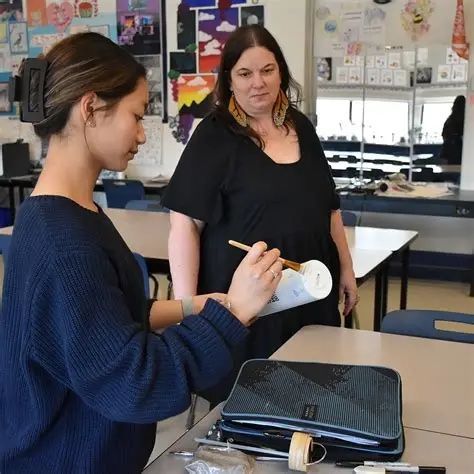
Ms. T Wins Manitoba Teaching Award
Ms. T has been teaching for many years at St. James Collegiate. Currently, she teaches Geography, Global Issues, and First Nations, Inuit and Métis Studies at the high school.
Former SJCI Principal Steffler wrote, “ Tara is a driving force in shaping an inclusive school where students believe in themselves and feel engaged within and beyond the classroom. “There is no equal to Tara's leadership in promoting environmental, cultural, anti-racism, diversity and social justice initiatives or how she delivers holistic education.”
Ms. T. has played an instrumental role in numerous projects among them
- Helping to establish and/or support student groups including the Eco Jimmies, Culturally United and Sacred Peoples Circle.
- Establishing St. James Collegiate as Winnipeg's first Fair Trade School in 2017.
- Securing a Green Circle Salon designation for the school's Vocational Hairstyling Program in January 2023.
- Obtaining numerous grants to support sustainability, address the impacts of poverty, and tackle social justice issues.
- Coordinating the school's UNESCO initiatives since 2015.
- Hosting or supporting the coordination of awareness raising or community-building activities, including a school-wide Wellness Day, International Women's Day, Earth Week, events associated with Missing and Murdered Indigenous Women,…, Culture Fest, the Celebration of Festival of Lights, Bear Clan walks and a community feast.
- Planning and executing monthly, school-wide Truth and Reconciliation lessons for three consecutive years.
- Engaging students in cultural enrichment activities such as ribbon skirt making, art workshops, hoop dancing, and beading classes.
And what does Ms. T say about her award Tara feels grateful for the provincial recognition, and the support she receives from the school. She says it felt cool and fancy to hear from the other winners at the award ceremony, but her acceptance speech and mind quickly returned to her work, and the many initiatives she has on the go.
“I'm constantly being challenged," she explains, adding there is always something new to consider or integrate into her teaching, especially given her humanities focus, constant changes in society, and student needs like mental health and nutrition. “I have a lot of flexibility in what I teach," she says, “what isn't a global issue?"
Ms. T- we are all so proud of you!
The Advanced Placement Program
Once again, as enrolment waned at SJCI, the Division stepped up to create programs to attract students. One of those programs was Advanced Placement (AP) which was a Program offering college‑level courses and exams to high school students, allowing them to earn college credit. It provided rigorous curricula, annual May exams scored on a 1–5 scale and was recognized by over 4,000 institutions globally.
In 1988, Mr. Monk, our Vice Principal. was tasked with administering the program. He sought out veteran teachers for the Program-Ms. Bilous for English, Mr. Feasby for Chemistry, Mr. D. for European History, Mr. James for Biology, Rob Martens for Calculus and Physics, Mme. Weinstein for French. Mr. Monk also went to several schools to ‘recruit’ high achievement students for the Program. Arlan Gates, who chose to come to SJCI, wrote, “How fortunate we were to have access to that program and to such a dedicated team of excellent teachers. The English AP course, taught by Mrs. Bilous, was another highlight and remains one of my fondest academic memories from that time.”
As teachers, we had no clue as to what was on the exam. Keep in mind, there was no definitive course outline. It meant that a teacher could teach history chronologically, or on an economic basis or a social basis. It was up to us as SJCI teachers to do the best we could with our students and the broad course outlines.
All AP teachers received a ‘study’ class prior to the start of the program year. That gave us a chance to pore through the various syllabi and to gather appropriate materials for classrooms and the School Library. I spent countless hours at Red River Books on Princess Street buying all manner of European History books, (for not a lot of money!).
Although the AP program had not officially started, I had two students, James Johnson and Rick Bales, challenge the European History course and exam. We met during study periods, at my home, the cafeteria, the school library. The key was to score three or better. Both of my (un)official students did just that. James wrote, “The course was very similar to regular European history. Same time frame and such but a bit more in-depth. I ended up getting. 4 out of 5 on the exam which was enough to get me a university credit although that credit was given a 3.0 grade point which isn’t great but not terrible either”. The next year, SJCI boasted a solid group of high achievers and many scored fives on the exams. The next year, I had a group of students who were just plain hard workers. We beat the national averages! Some of our students were given an ‘assigned’ university credit at the University of Winnipeg.
The following year, the enrolment could not sustain scarce teacher resources, and the Program gradually disappeared.
James Johnson (student), Arlan Gates (student), Mr. Monk, Mr. James. Mr. D.

The Fire of ’85 (Part 2) - The Rise of the Phoenix
From the fire and ashes of the West Wing a new era in the school was born. A bigger and better Jimmie’s Junction, a bigger and better student cafeteria, a bigger and better staff room.
Ms. Young was instrumental in facilitating many of these improvements. All of these changes made for a more relaxed, friendly atmosphere among students and staff.
Jimmies’ Junction had a fresh new space fronting onto the hallway. The Marketing classes ran the retail operation. It sold snacks, school branded merchandise with Mr. Kaleta in charge of operations.
The Student Cafeteria was expanded and brightened with moveable bench seating. There was a frontage onto the cafeteria proper so students cold come up and order and there was a side window into the staff room so that staff could order breakfasts and lunches, coffee / baked goods.
One of the most notable and beloved cafeteria operators was Skip Scott and members of the Scott Family Skip had operated many restaurants through the years. His fries and gravy were student favourites. And Skip was not averse to helping a student whose family situation may not have been the best.
Diane Scott, Ms. Young, SJCI Vice Principal, Winnipeg Free Press, Carey Lauder
SJCI and the Royal Canadian Legion #4 (Part 3)
St. James Collegiate is the oldest Collegiate in the Division. All of the veterans of St. James would have attended this school. In the early 1980s the Student Council created the Memorial Wall which listed the name of all those who fought and those who died. Aging men and women of our community have wept as they read the names of loved ones and friends forever preserved on our Memorial Wall. Our Remembrance Day services have earned comments, and even tears, from our guests about the profound respect shown by our students for people and events far beyond our years.
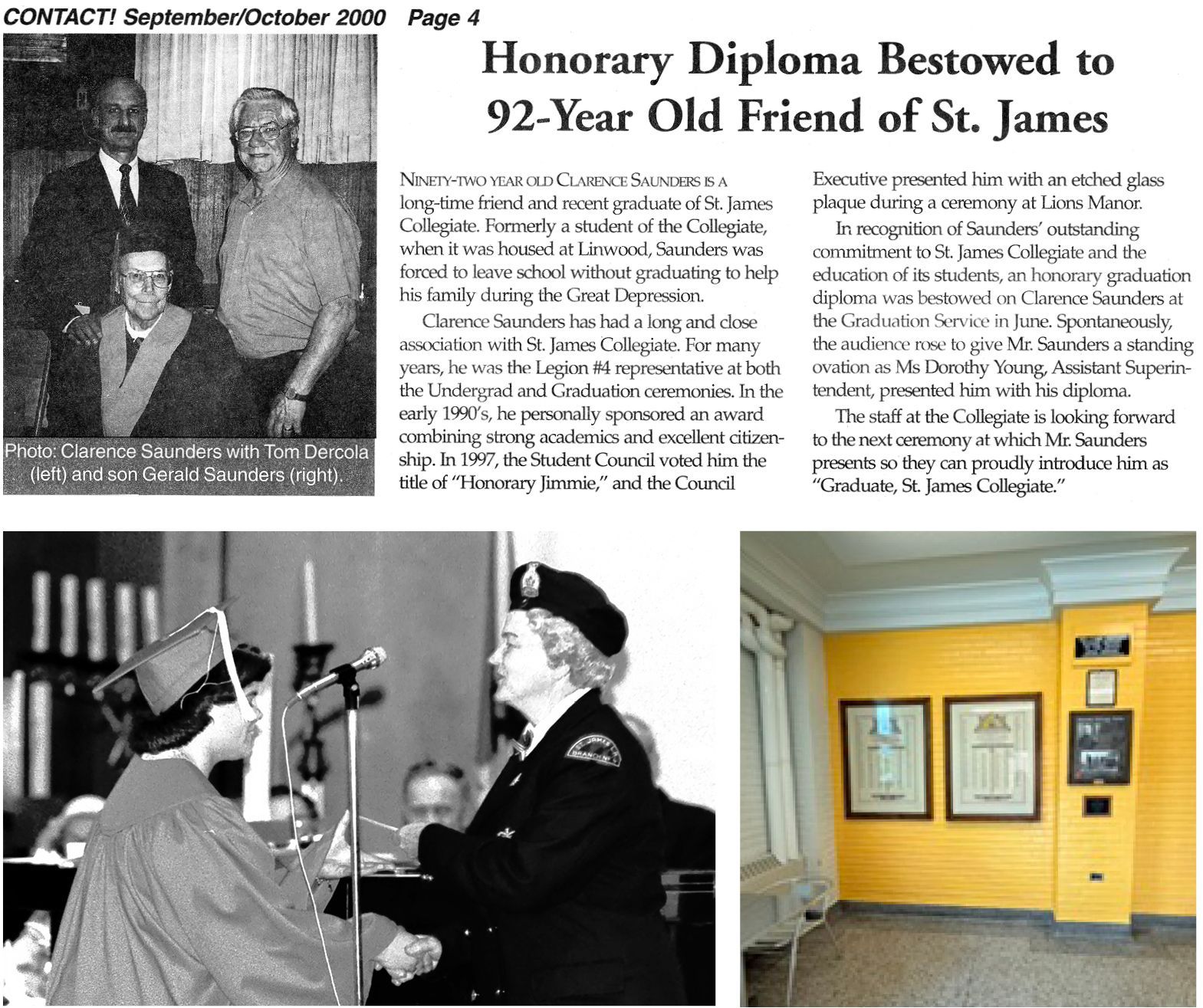
The Legion continued to provide scholarships and bursaries at Undergrad and Graduation ceremonies. The names of the guests from the Legion were so familiar to us– MS. Psooy, Eric Murphy, Mr. Saunders.
That these men and women are remembered dutifully by their next of kin and only occasionally by Canadians during the two-minute silence each November 11. Each year the staff and students of SJCI continue to honour those men and women at our Remembrance Day service. And each day, we continue to honour them with the plagues in the east entrance to the Collegiate
Demographic Change & New Programs # 1
Population growth at the east end of the Division remained static but the school age population did not. Empty nesters remained in their homes and the population at SJCI began to drop. In the early eighties, the Division called upon the schools in the east end to conduct an area review to ameliorate the situation. Teachers and parents from Deer Lodge, Stevenson and SJCI met regularly for two years to devise a strategy.
The decision was made to close Deer Lodge and Stevenson as junior highs and transfer the students to SJCI, which became a 7-12 secondary school. Brooklands High School had already been closed (1972), and students were being bused to SJCI or Sturgeon Creek.
Specific vocational and specialized programs were instituted -Cosmetology, Autobody, Advanced Placement and an all-encompassing technology program which covered Grades 7-8, 9 and 10-12. This technology program is the one we will examine in this reflection.
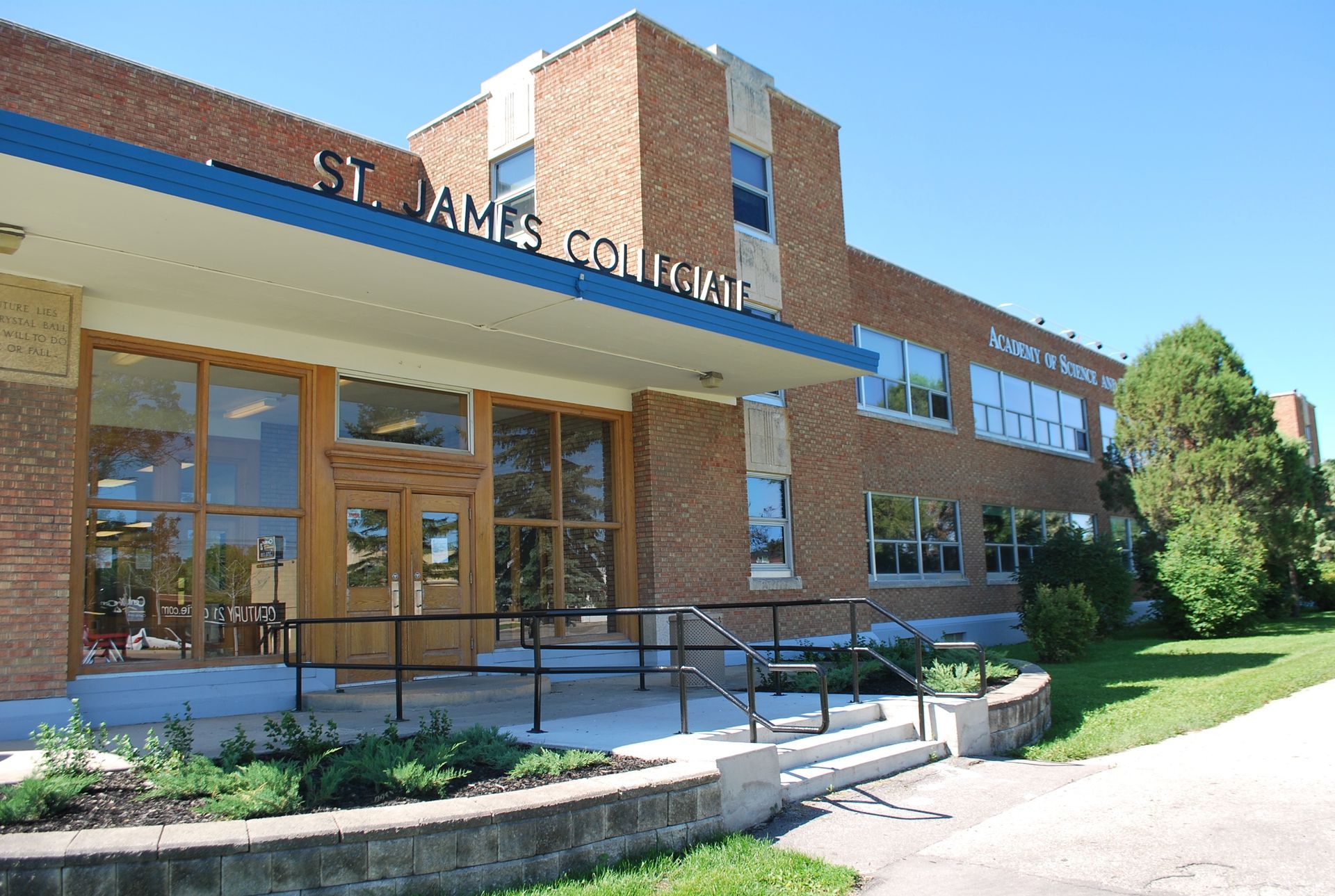
New signage on the front of the building heralded “Academy of Science and Technology.” New science labs were constructed. There was the VEST (Virtual Enterprise Systems Technology) program for Grades 6-8 technology program. The ITC (Integrated Technology Concepts) program was specifically for Grade 9 students and the IST (Integrated Systems Technology) program for Grades 10-12.
These programs were truly state of the art and provided a seamless transition from Grade 7 through Grade 12. Mr. Ingram recalls, “it was the only program of its kind in western Canada at the time that combined rigorous academics with hands on technical skills in areas like robotics, engineering, and plc programming. The program also boasted about teaching the all-important “soft skills” that industry is still looking for today including skills like time management, working with others, communicating, and presentation skills. Grading and all skills associated with these programs were all barcoded for easy identification and assessment. Students were even assigned barcodes and as the students became proficient in the skill that they were mastering I would circulate the room with a barcode scanner and book of barcodes and scan the students’ name, the skills they were demonstrating and assign an assessment mark based on a mark of 4. It was truly authentic assessment before its time.”
-Mr. Ingram

Cosmetology: A Cut Above the Rest
One of the innovative programs introduced at SJCI in 1982 was Cosmetology. Two classrooms (rooms 3 and 4 in the original building) became the Cosmetology Lab.
Mr. White became its first instructor that year. He took a cosmetology course and worked at Ken Pruden’s Hair Salon and then went back to the University of Winnipeg to obtain his Bachelor of Arts and Bachelor of Education degrees. in 1985 he was presented with an award as one of the finest teachers by his grade 11 and 12 class. He left SJCI in 1990 to become the Coordinator of Industrial Arts for the School Division. Sadly, he passed away in 2023.
Mrs. Tapping started her career as a hair stylist. Five years later, she obtained her teaching certificate and replaced Mr. White at SJCI. She remained at the school until 1997.
Mr. Scarpino came aboard in second semester of 1997. Some 30 years later, the man is a legend. Five years ago, the Cosmetology room suffered a devastating fire. It started in the early morning of December 19, 2021. It started in the backroom dispensary where three electrical panels were located. The fire inspector said it was faulty wiring. No matter, the damage was quite extensive; the entire room was destroyed. Everything in the room was removed and it took eight months of arduous work to replace. Mr. Scarpino wrote, “The only difficult time I experienced during my years at St. James were during the renovation of my classroom after the fire which disrupted my teaching schedule”. The course has changed so much with hairstyles and trends over the last 27 years, and I have had the honor of teaching the most amazing students who made my job easy!”
For the Reunion Mr. Scarpino will be displaying hair from each decade with the help of exceptionally talented students. There will also be pictures throughout the room of the old lab, the devastation from the fire, the renovation before the fire.
The New Gym:
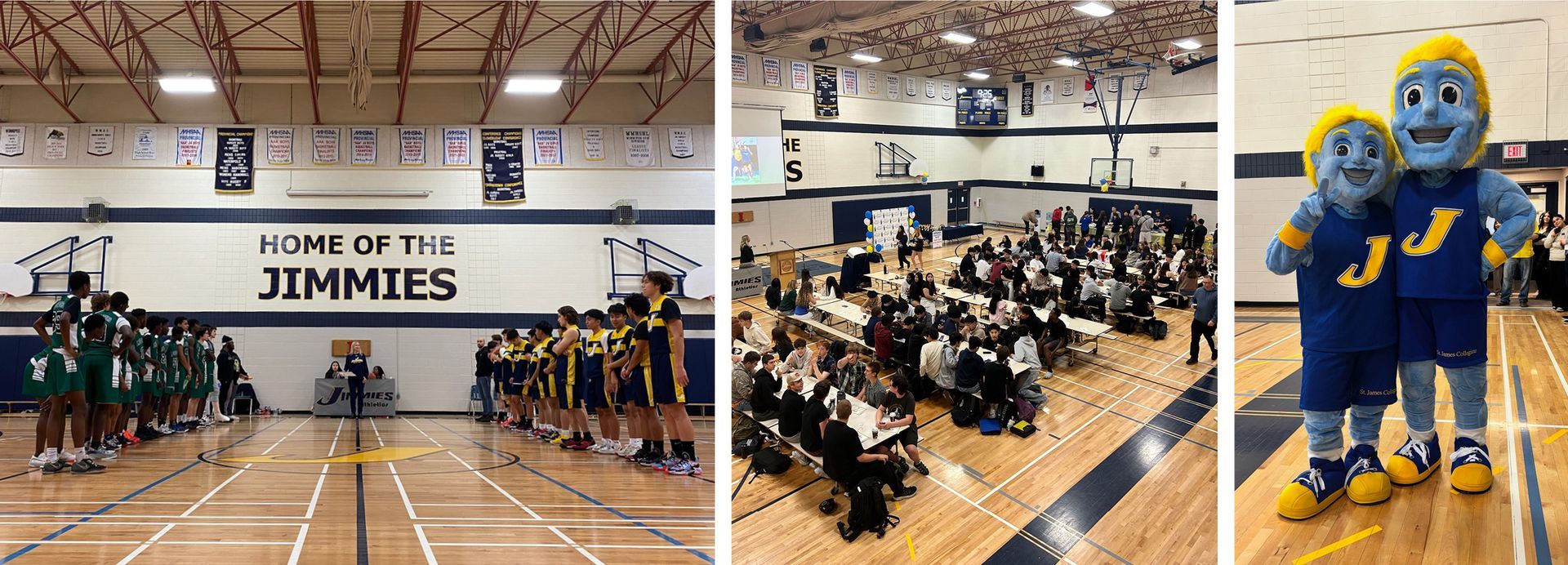
SJCI’s third gym opened in 2001
The new gym has been a focal point of life at SJCI for the last 25 years. It has hosted a lot of divisional events including many divisional band concerts and science fairs.
Athletics took a huge leap forward. In 2002 SJCI joined the West Winnipeg Athletic Conference- JT, Westwood, Sturgeon, Silver Heights, Oak Park, Shaftesbury, Fort Richmond, and Vincent Massey. Two years later the Winnipeg Conference for basketball and volleyball was created which included all WWAC schools and all Winnipeg 1 Division Schools!
Our great new facility allowed us to host 2012 Tier 2 Varsity Boys and Girls Winnipeg Basketball Playoffs. To brag a little the Boys defeated Sisler Collegiate in overtime and the Girls defeated Tec Voc. The next year we hosted the 2013 AAA Boys and Girls Basketball Provincials.
Here is a list of recent SJCI Team accomplishments.
• 2011 & 2016 Varsity Boys Basketball AAA Provincial Champions
• 2022 Varsity Girls AAA Provincial Champions
• 2011, 2012, 2013 Varsity Boys Tier 2 Basketball League Champions
• 2006, 2011, 2012, 2013, 2020, 2022 Varsity Girls Tier 2 Basketball Champs
• 2015 Junior Varsity Boys AAA Basketball Provincial Champs
• 2010 &2012 Boys Handball Provincial Champs
• 2025 Rugby 7's Champions
– In gratitude to Mr. Kangas for the text and Ms. van Aggelen for the photos
Community Philanthropy (Part 2)
The Student Councils of SJCI, over the years, have supported a wide assortment of community causes.
Before strict rules about music licensing came into effect, sock hops run by student DJs like Randall Bradfield and other members of the Radio Club were a regular noon hour activity. For several of the hops, we “Danced for the Rainforest” and money was donated to the World Wildlife Fund. Other soc hops supported Darcy’s ARC, then located on Portage Avenue at Hampton Street. Donations helped to buy large containers of cat litter. When students dropped off the supplies, they fell in love with Fipper. Darcy’s mascot dog had been burned with battery acid and student hearts melted. Soon, students were volunteering at the center.
Another one of the great community initiatives involved “Clean Up” Day. Students, armed with gloves and garbage bags, spread throughout the local community. The process was not limited to the school grounds. Groups headed to Bruce Park, to Truro Park and the Creek area, along Ferry Road, around the Public Library. We had great support from SJCI custodian, Mr. Palmer and Take Pride Winnipeg.
The St James Collegiate Variety Show was true to its name. From its debut in 2004, the purpose of the show was to give our talented SJCI students an opportunity to perform for a large community audience. Over the years, the show included everything from Irish dance (Jessica San Diego) to bagpipes (Reanne Schedlosky), from rock bands to guitar solos (Justin Baraniuk), from hip-hop dance (Brendan Gali and others) to the Chinese yoyo (Jimmy Chau). Over the years, many great singers performed in the show, including Amanda Cannon, the Mansaray sisters (Timocia and Marcella), Amanda McRae, Hunter Romas (in a tribute to Johnny Cash), and Harrison Schwartz (doing “Ol Man River”). And no one who was there will ever forget Chris McLellan’s spot-on rendition of Napoleon Dynamite’s dance moves.
The other purpose of the Variety Show was to raise money for the Canadian Cancer Society. Through tickets sales and donations, the show raised over $10,000 towards cancer research and treatment.
– Mr. McLeod, Mr. D.

Team Handball
Mr. Kopchuk was a driving force in so many facets of school life, none more so than Team Handball. Team Handball-try to imagine football on a gym floor! In 1983, his seventeen-member Male team captured the Provincial Championship. His hard work and dedication put the sport back into the SJCI spotlight.
Some basic rules:
- After receiving the ball, players can pass, keep possession, or shoot the ball.
- Players are not allowed to touch the ball with their feet. The goalkeeper is the only player allowed to use their feet, but only within the goal area.
- If possessing the ball, players must dribble (comparable to a basketball dribble) or can take up to three steps for up to three seconds at a time without dribbling. Notable scoring opportunities can occur when attacking players jump into the goal area.
In 1985, Ms. Hart and her female team captured their Provincial Championship. The team had so many strong athletes, among them Myra Duke, Marni Rauhaus, the Morley sisters, Kathy and Patty, and Robyn Netterfield.
In 1987 and 1989, Coaches Tom Miko and Jeff Johner, former SJCI players, coached SJCI teams to the Provincial Championship. Notables on both teams included Trevor Nott, Roy DuQuette, Peter Buscemi and Matt Corrie. Many of our handball players went on to become stalwarts in the Winnipeg Team Handball League.
Brandy Westcott, who was an educational assistant at SJCI, coached the team in the early 2000s. The SJCI Boys captured the Provincial crown in 2010 and again in 2012.
– SJCI Sports Hall of Fame, Mr. Kangas and photography by Carey Lauder
Idealism vs Reality
In 1969, one of my courses was Modern World Issues. Major topics included prejudice and discrimination, population growth, war, and conflict.
One of the problems I faced was the lack of current texts and materials. There were no photocopiers at that time and SJCI had Gestetner machines and spirit duplicators. Even if I could type (which I didn’t. still don’t), the machines and their supplies were ‘jealousy’ guarded. For any typing of Gestener sheets, I had to rely on one of the school secretaries and rely on them to operate the machines. They were off limits to the staff. Miss Mathieson, who was one of the vice-principals, 1959-1970, cautioned me about the use of paper.
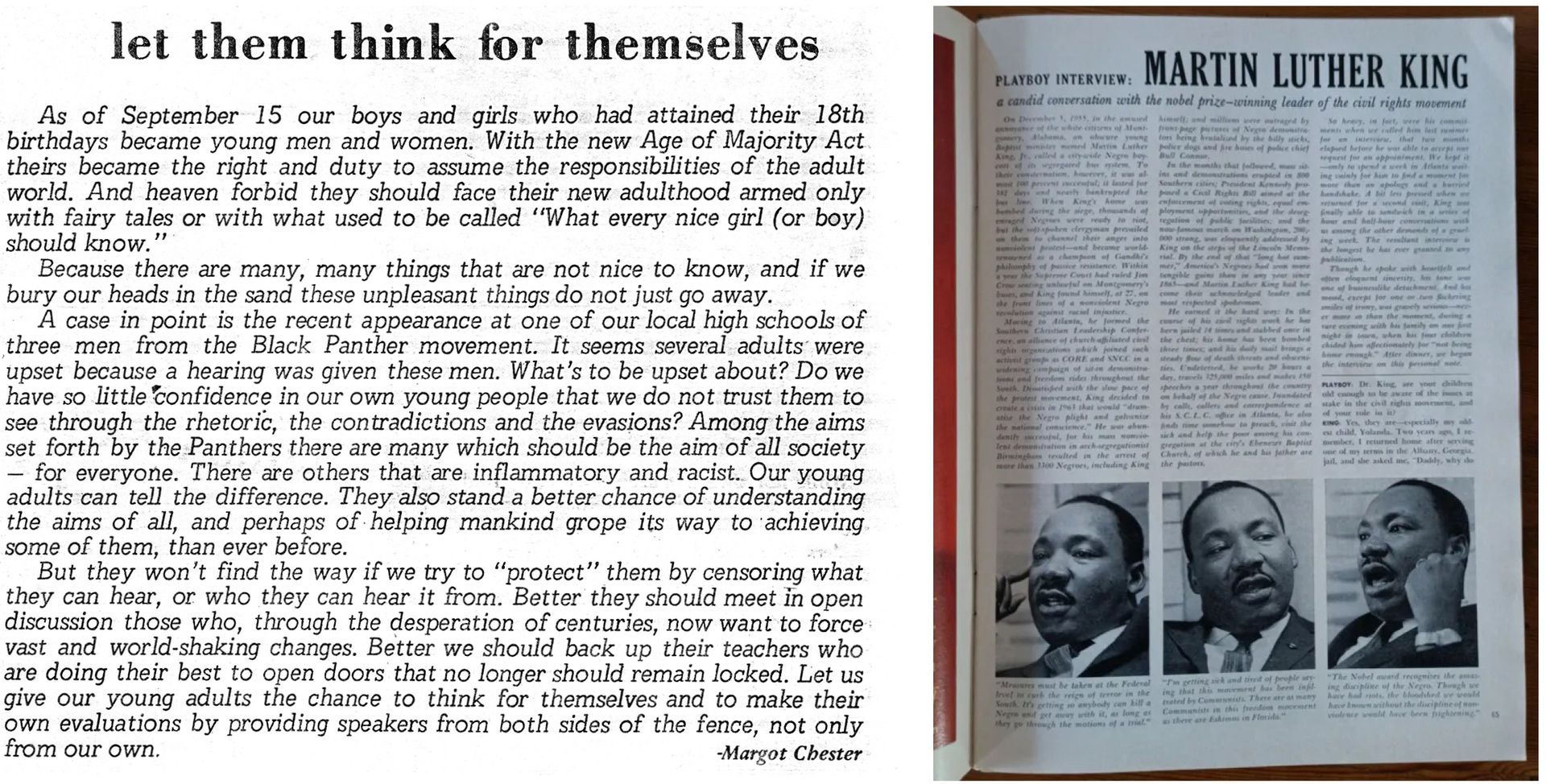
Being young and idealistic, I looked for other current, relevant source material. I created file folders of the topics of study and filled them with all sorts of clippings from Reader’s Digest. The Winnipeg Tribune, Time, Newsweek, and Playboy. (There were great interviews with Martin Luther King Jr. and Paul Ehrlich and excellent articles about the Vietnam War).
I also visited Progress Books on Selkirk Avenue; it was a decidedly propaganda outlet for the Communist Party of Canada. I used them to show students how propaganda was a tool of oppressive regimes. However, that earned me a visit to RCMP Headquarters for an interview.
I ordered 16 mm films from the Division Library as well as picking up films on regular runs to the Department of Education Library on Wall Street and Portage. SJCI had a couple of film projectors which had to be booked for my showing dates and time. Like the written material, many of the films were dated and in black and white.
I invited speakers including representatives from the Manitoba Indian Brotherhood and from the Black Panther “Party.” The latter group was really a ‘wannabe’ group, and my students, who had prepared very well, truly demolished their inconsistencies and lack of knowledge.
However, during the noon hour presentation in the Theatre, a school trustee was in attendance and then the proverbial fertilizer hit the fan.
– with memories from a young teacher
Wall of Fame … Twenty Years and Counting
Students would have to achieve ‘success’ in two or more of four categories, academics, sports, community service, and special achievement. A teacher committee would meet every six weeks to review the nominations. Staff, parents, or students themselves could submit nominations. The committee reviewed the nominations and selected 12-14 students for the awards ceremony at the next student assembly.
The committee looked at more than students who had A averages or who played on school teams; it looked as well at students who made changes in their approach to their schooling. A recipient might have bumped their average from a middling D to a solid B or it might be the student who challenged themselves to become involved in intramurals or school teams or a student who went out and did some spirited community service or who made an outstanding effort beyond the school environment in athletics, the arts or the community. An outstanding example was a student who, after seeing the names on the Wall of Fame, raised their average from 56 to 75, tried out, and made two school teams, ran an after-school sports program at one of the Division’s elementary schools. What an amazing turnaround! And there were so many stories just like that one.
The recipients would be honoured at a school assembly in the NEW, 2001 Gym. They sat by the Honour table where Mr. D. would pass the printed award certificate to Mr. Mutter who handed the ‘winner’ their certificate and an engraved plaque. The plaque was then affixed to the Wall of Fame. One of the most impressive aspects to the student assemblies was the enthusiastic response of the students in the bleachers.
The program continues to this day. Today, it is called the Success Assembly with six categories: Arts and Music, Citizenship, Athletics, Leadership, Academics and Culture. Mr. Sculthorp who has taken charge of the program tells us, “our students enjoy being honoured and they LOVE cheering for their peers.”
Mr. Sculthorp, Mr. D
Water Polo League Play
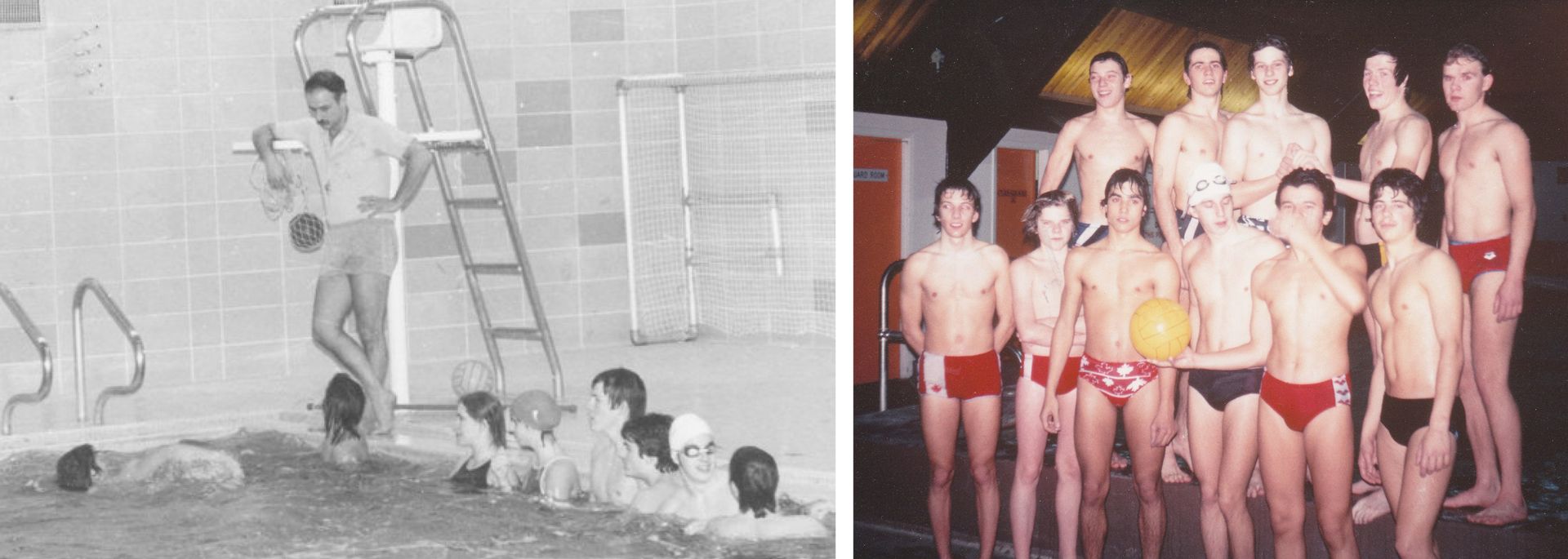
Our first foray into the sport of water polo took place in the 1970s when our team practiced and played at the St. James Y at 150 Ferry Road (now the location of the Colorado Estates). In 1973, with Phys-Ed teacher Ms. Whyte, the Jimmies were the Regional Water Polo Champions. The Co-ed team, led by Paul Mutimer, Gerry Neufeld, Gerri Hall and Cheryl Richardson, was our last winning team until the early 1980s.
Then, once again, there was a core of strong swimmers. We were able to form both a men’s team and a coed team for Division and tournament play. However, more than strong swimming skills were needed to play. Stamina was critical. Our team played four, eight-minute quarters and substitutions only took place at designated times. The ball could only be handled with one hand, and a shot had to be made within 30 seconds.
Learning to tread water or the "eggbeater kick" was critical. It allowed players to keep their heads above water without expending too much energy, and provided enough stability in the water to catch, pass, shoot, and defend.
Our players were ‘cautioned’ to wear two speedo swim suits. Speedos offered less drag but also protection against the clutching and grabbing that occurred under the water (unseen by the referee on the pool deck). Chlorine took its toll on the suits but most importantly, there was always the possibility of one being torn during play. So, it was one night at the Pan Am Pool when one of our female players raced after an opposing player, grabbed and ‘accidentally’ tore the suit of a female player from the other high school. Things got a bit cheeky at that point.
In 1985, Kirsten Helgason, a former SJCI player coached our team to the PROVINCIAL ‘B' CHAMPIONSHIP with stalwarts, Graham Allardice, Lilly Olson, and James Franks. In 1987, Coaches Mr. Kutcher and Cindy Flett had many of the same players from the 1985 team to capture the PROVINCIAL ‘B' CHAMPIONSHIP again.
Cindy went on to coach Canada’s National Women’s team and Lily Olson became involved in Water Polo Saskatchewan as coach and administrator.
The Wide World of Mr. James’ Biology classes
Mr. James was a fixture at SJCI for thirty-three years! He had a vision that took his students beyond the walls of SJCI, but he also initiated dynamic student-centred programs.
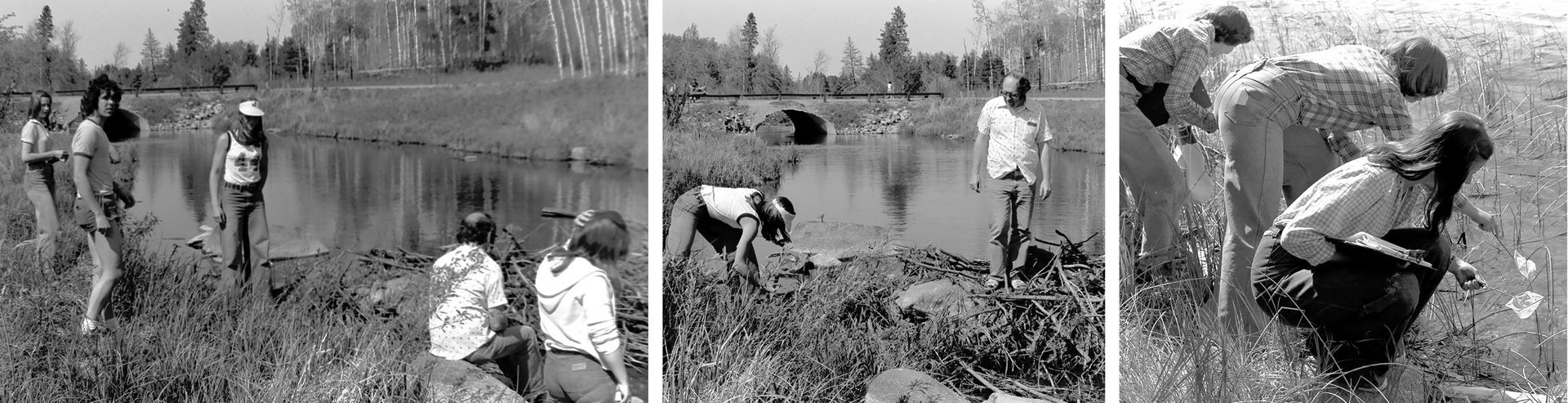
For twenty years, the semester one Grade 12 students attended a three-day ecology trip to the U of M Delta Field Station in December while the semester two students experienced a 3 day trip to Riding Mountain in late May or June. How many of you have visions of a whiteout blizzard or horses galloping outside the Park?
Other Biology students over the years experienced such places as commercial greenhouses, the Morden Experimental Farm, florist shops, genetics labs, hospitals, Fort Whyte, Oak Hammock Marsh, Assiniboine Zoo, and diagnostic labs.
Many of you may have been part of his Horticulture course. He had some of his students apply for a grant and a greenhouse was built on the school roof over a summer.
This led to his initiating a Grade 11, and later, a Grade 12 Horticulture course. The programs ran for twenty years! The classes raised and sold poinsettias and Easter lilies to the teachers and community as well as bedding plants in the spring. Horticulture students also made the flower arrangements for several of the school graduations. Students help build a fenced garden at the back of the school in which students grew vegetables that were made available to the community. The Horticulture classes also planted the school flower beds in the spring and did some of the landscaping.
Recollections by Mr. James and Photos courtesy of Carey Lauder
Intramurals - Off the Beaten Track
Over the years, many intramural games such as team handball, floor hockey, basketball played in the “New Old Gym” (now the George Waters Middle School gym). But the gym was not the only place where intramural activities took place.
Mr. Bachmann ran a popular table tennis club during the lunch hour from classrooms on the second floor. The desks were move around and the folding table tennis tables brought out.
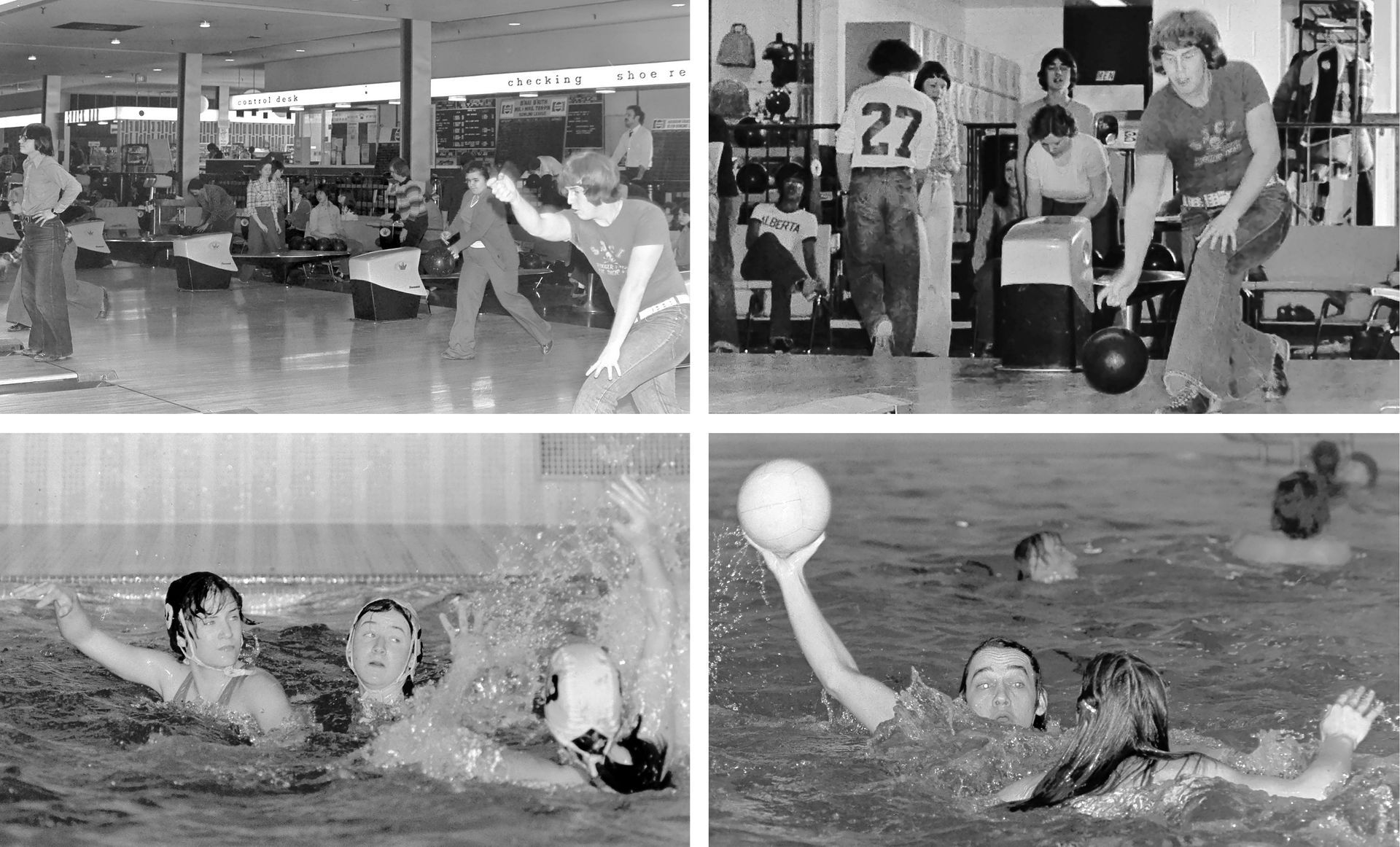
Mr. D, who had worked in his teen years at Empress Lanes (now, the Polo Park Inn) organized a ten pin league for students and staff right after the end of the school day. Once a week, 7 to 8 students packed themselves into Mr. D. 1969 Mercury for the jaunt to the bowling lanes. There were many student teams and a staff team, mostly of the social studies teachers. Ten pin bowling was a new experience for most who had grown up with the five pin game. (Ten pins to knock down and a bowling ball that weighed up to sixteen pounds). We were able to get free games as prizes for top score, next strike, convert a spilt. A regular sight was Mr. Sozansky torquing his body in so many ways as he tried to ‘coax’ the ball down the lane.
Another off site sport was water polo. Building on the success of the school teams, we created a co-ed league at the St, James Civic Centre after school. There was so much interest that we had over thirty-two players spread across four team. School team players became the captains and drafted their teams so that teams were balanced with newcomers and veterans and with a male / female ratio. The Civic Centre was ideal because of a shallow end that allowed less powerful swimmers to stand and catch a breath. The sport continued until City rules required a certified lifeguard.
Photos Courtesy of Carey Lauder.
SJCI and Legion #4 (Part 2)
SJCI is forever grateful to the men and women who served our country during World War II. We are grateful too for their ongoing support of our community.
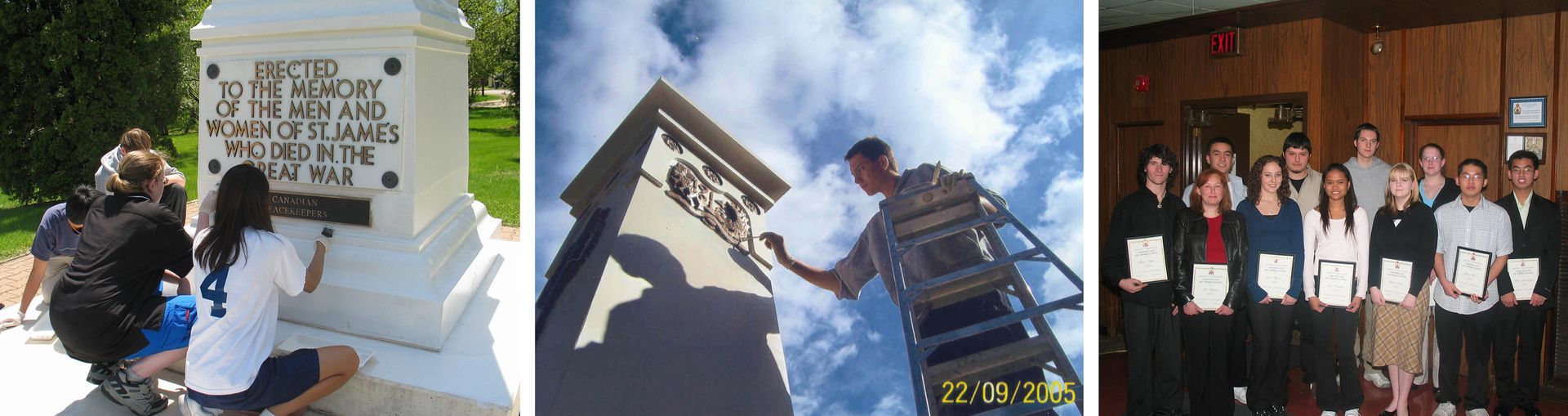
Beyond our Remembrance Day ceremonies, we wanted to honour their contributions in a unique way. We were able to do that in the mid 2010s.
The Cenotaph in Bruce Park has been the focal point of Remembrance Day ceremonies over the years. Each November 11, there has been a walk from the Legion to Bruce Park for formal ceremonies and the laying of wreaths. However, over the years, the paint was peeling and the rosettes that adorned the Cenotaph were cracked and broken.
Mrs. Hamelin first brought the idea of restoring the Cenotaph to a Grade 10 (spring of 2004) English class after the students read Generals Die in Bed. We spent a couple of next classes painting the lower half of the Cenotaph, planting flowers, and cleaning up garbage.
Thanks to the support of the SJCI vocational department teachers, the ‘rosettes’ were refurbished and strengthened.
In the fall of 2005, a smaller group of us spent a couple of mornings painting the top half of the cenotaph and replacing flowers which had gone missing. Later that fall, the St. James Legion invited us to a meeting where they acknowledged our work with framed certificates of appreciation.
The caretaking has continued! Mrs. Hamelin joined a small group of us a few years later to give it a fresh coat of paint. I continue to check each summer and, every handful or years or so, I add a fresh coat of paint and cast new flowers to replace ones damaged or missing. I just replaced a couple of the flowers last summer (2025).
Thanks to Chad Kipling for the text and the photographs.
Graduation ‘Exercises”
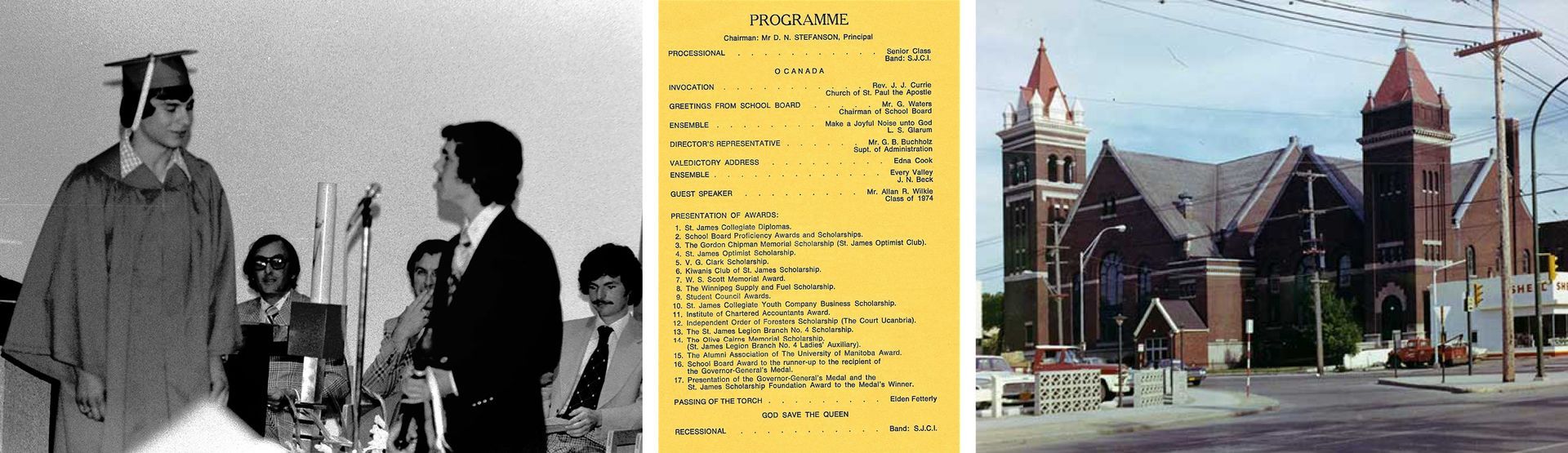
In the early years of the Collegiate, Graduation exercises took place in the first week of June. Students wrote Provincial exams in all their subjects and never really knew if they had graduated until July when the results were mailed out. Hence, ‘exercises’ vs ceremony.
Until the mid 1960s, students sat for mandatory provincial external exams in multiple grades, but of note were the Grade 12 finals. All Grade 12 university entrance students wrote five different exams, one for each of the course they took. Failure in any one course, usually meant night school. Keep in mind, there was no semestering, no split year, courses arm for ten months.
With large ‘graduating’ classes, often more than 300 students at SJCI in those early years, graduation exercises took place at some of the larger older churches. SJCI held its exercises at Young United on Broadway for a number of years.
The ceremonies themselves were standard. O Canada, an Invocation by the church minister, greetings from various Division dignitaries, musical interludes perhaps by a student or the school band, a valedictory address, perhaps a guest speaker with words of encouragement for the future and the presentation of scholarship and bursary awards. Of course, the awards were granted on the basis of the work the student had done prior to June. Finally, there was the passing of the torch from the outgoing Student Council President to the President-elect.
As final grades fell to the school division, there was a lot of variation, but essentially, the final evaluation fell to the individual schools. Plus, by the early 70s, semestering was instated in the high schools in the Division.
Photograph courtesy Carey Lauder
Memories of Being a Grad Chair
As I roll back the pages of time, SJCI will always be a part of my early years and the foundation I created. Friends, high school sweethearts, laughter, classes and SO much more!
So here we are… fifty years later. Wow! The years fly by in a blur! I am eternally grateful for my childhood friends who are still in my life. You all know who you are. When Mr. D came to me several years ago to help create the 75th reunion, I couldn’t possibly say no!
My first event was being Grad Chair in 1976 and fifty years later, my last event will be the 75th Reunion. What a perfect way to cap and gown my career in Event Management! Tom (who was always one of our favourite teachers), and I have stayed connected over the years in other areas of life… charitable connections, radio connections and board connections. What led to our ongoing relationship was my chosen profession as an Event Producer/ Manager.
And taking this a step further back… being a grad chair at SJCI obviously made a big impact on me, long before I even realized it. As a Grade Twelve student, who knew that my career would unveil itself in event management?!
Working as a Grad Chair was a great experience. I loved working with the teachers involved and my fellow students to create a memorable experience… the car decorating, the ceremony, the dinner, the boat cruise and the breakfast. Oh, and the fashion at the gala! We can all sit back and say… those were the days my friends.
The irony of the experience was I did not graduate from SJCI with all of the 1976 graduates. Before you tsk tsk me… let me explain… My life was jam packed with school, a part time job at Dalmy’s Polo Park (you all remember that cool store… pipes, bathtubs and toilets), an intensive competitive dance regimen and also competitive baton twirling with the Winnipeg Blue Bomberettes. Oh, and that high school romance, which eventually became a marriage and daughters.
The good news is that I completed my last university entrance course several months after graduation. So, I got the job done! I have continued to be a lifelong learner… courses, conferences, classes, etc. I seemed to learn how to multitask at a young age and prioritize what needed to be done for my own needs and the success of a project.
I never considered myself a conventional, linear thinker, but more of a big picture thinker. I thank many of my teachers over the years for the contribution of this important skillset.
Being the Grad Chair supported these valuable skillsets that have also supported my wonderful, successful, sometimes stressful, sometimes zany career path. I wouldn’t give up a moment of these memories! Thanks SJCI! I am eternally grateful. Never discount your high school experiences, as they can lead you to great accomplishments in life. Sometimes in a very unexpected, grateful way.
Here’s to another seventy-five years SJCI! Thanks for the memories!
Janice Cook (Shipley- Currier)

Curling
Over the years, curling did not involve a large number of students. However, SJCI’s success in the sport was huge.
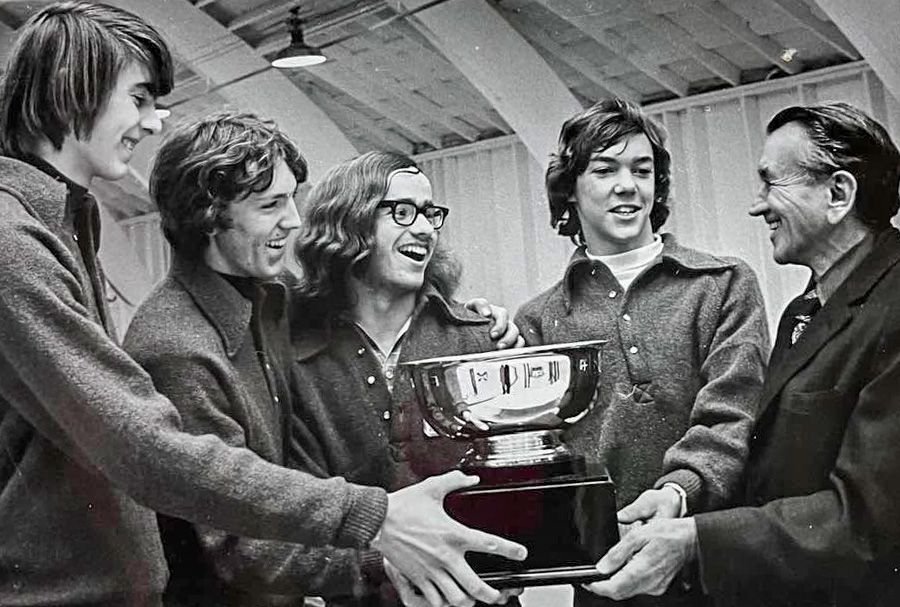
In our very first year as a school, our men’s team won the 1951 Manitoba High School Bonspiel Championship. The team was skippered by Norman Houck with Bruce Kidd, Bill Eggleston and Ron Cummings. Houck later skipped or played third on teams that won seven Manitoba and three Canadian curling championships.
In 1954, our ladies team captured the Division Championship. In 1962, the Men’s team were the Manitoba High School Champions. In 1966, the Men captured The Cloverleaf Championship.
The early 70s were the heyday of success for SJCI curlers. In 1972, with Mr. Rummery as their coach, our team won the Manitoba High School Championship. The team members were John Allardyce, Dave Iverson, Bob Christie and Pat Ryan, That team went on to win the Canadian High School Championship.
Ryan went on to become a World Champion skip, and three time Brier champion.
Mr. SJCI
It became one of the most widely anticipated events of Student Council’s Winter Carnival.
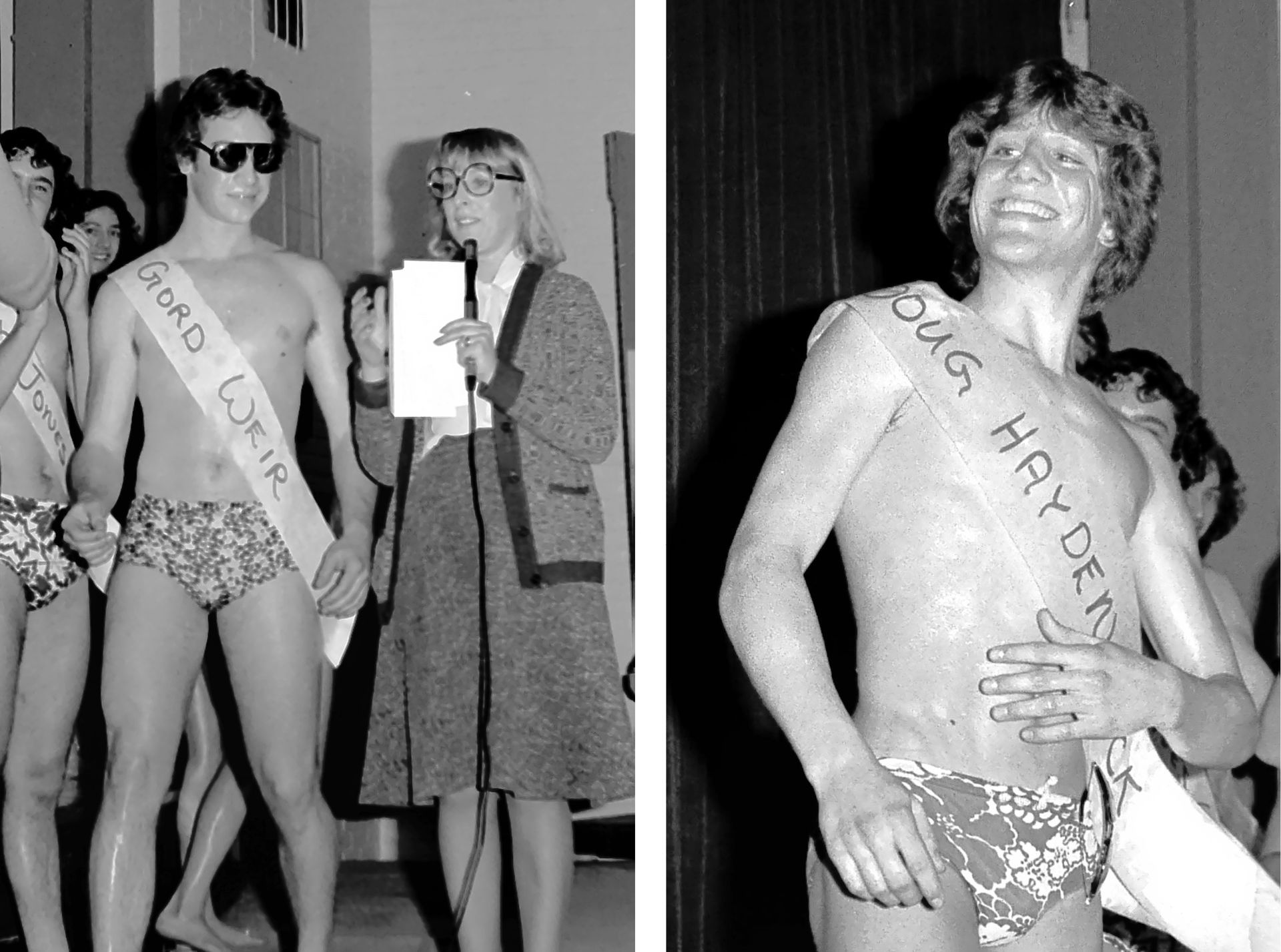
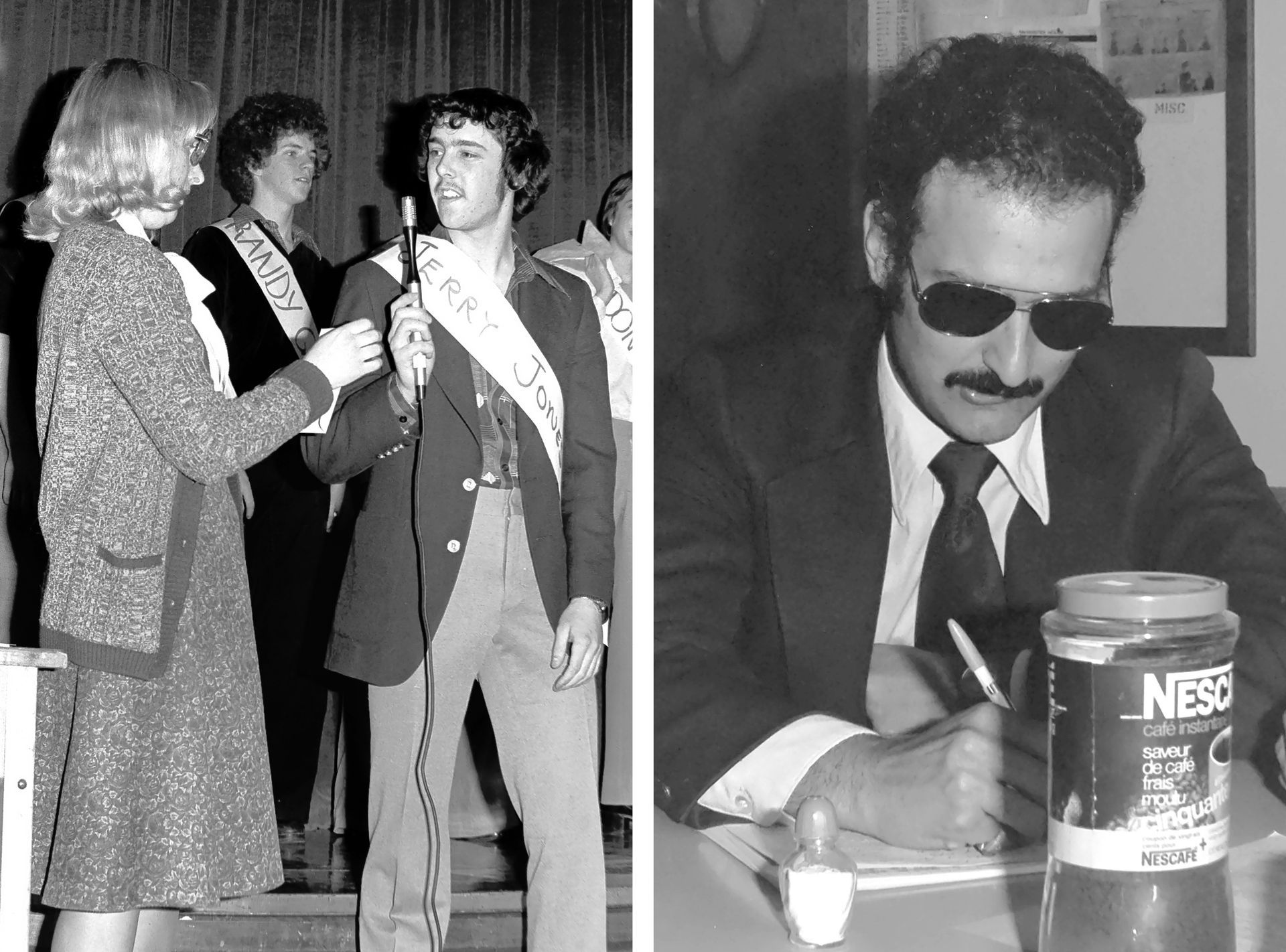
When Mr. SJCI first started in1977, female beauty pageants were the rage on TV -Miss Universe, Miss USA, Miss World. Student Council thought it be an interesting idea to create a ‘Male Pageant” that challenged existing ideas around the female pageants as well as a fundraiser for Student Council charities. Our guys would be judged on three criteria, poise, personality, and ‘body.’
Over the years, emcees for the event ranged from female Student Council members to staff members including Mrs. Phillips, Ms. Melnyk, and Mrs. Smith. The three-member judging panel was similarly composed.
Each participant would strut across the stage in his finest duds, often flashing the interior lining of his suit jacket. After each gent had his walk, he came to the microphone to answer a surprise question, e.g., ‘who would be your dream date and why’? or ‘what person do you most admire and why.’? At that point, the first of the guys headed to the change room where they hung up their fancy duds, got into their swimwear, maybe splash on some baby oil, lift a few weight bars. And, then back on stage for the muscle flexing. Even Mr. Kopchuk (d 2026) and Mr. Arnason acted as guest posers!
The female judges, again, staff members or Student Council females tabulated the results and declared a Mr. Congeniality, a Runner-up, and a Mr. SJCI. Each category received an award with Mr. SJCI earning the Blue and Gold sash.
The first winner was Doug Hayden-Luck and the final winner in 2002-2003 was Mark Lantz. In between, some winners included Craig Heisinger (1980), Mike Alexander (1981), Vince Runchey (1989), and Derrick Wall (1995).
Community Philanthropy (Part 1)
A great community initiative was The Mac and Cheese Challenge in 2003 for Winnipeg Harvest. The idea was to build ‘Christmas’ trees made of Mac and Cheese boxes in the front entrance. Mr. McLeod and Mr. D wrote a parody of O Tannenbaum which students sang at various places in the school.
O MAC AND CHEESE
O Mac and Cheese, O Mac and Cheese!
How lovely are thy noodles!
O Mac and Cheese, O Mac and Cheese,
How lovely are thy noodles!
You’re covered in a creamy cheese,
Hot or cold, you’re sure to please.
O Mac and Cheese O Mac and Cheese,
How lovely are thy noodles!
O Mac and Cheese O Mac and Cheese,
Much joy with ketchup doth thou bring!
O Mac and Cheese O Mac and Cheese,
You make me want to hop and sing!
Each box doth hold its tiny light,
To make a Harvest Christmas bright.
O Mac and Cheese O Mac and Cheese,
How lovely are thy noodles.
- Lyrics by G. McLeod and Mr. D
It wasn’t long before one full sized Mac and Cheese tree had been constructed. Then there was a second one, and a third. Once the project was finished, we called Winnipeg Harvest and their first truck could not take all that we had collected. So, out came a second truck. In all, the students and staff collected over 8, 100 boxes!
In January 2005, Student Council challenged students to fill a couple of big water jugs with pennies and coins. As jugs were filled, teachers would accept some dares. Some students took ten and twenty dollar bills across to the bank and loaded up on coins.
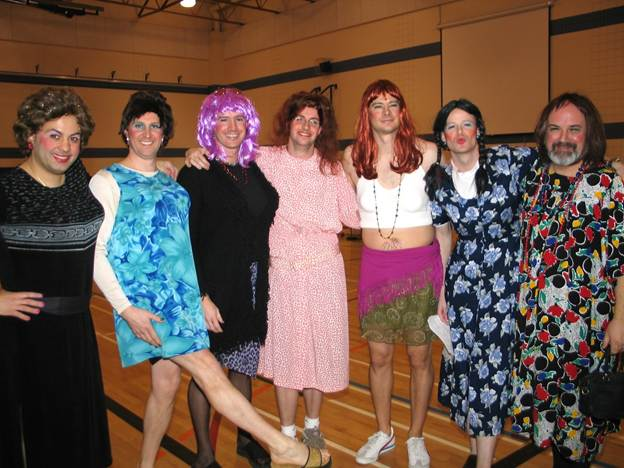
Some female teachers accepted another dare and performed as the Spice Girls, among them, Ms. Werner. In still another dare, Mr. Wake agreed to a wax peel (ouch, that hurts!). Over 1000 dollars was raised for tsunami relief.
A group of male teachers agreed to one of the dares and came dressed as women Messrs. Scarpino, Baydock, Carson, Kangas, Hayward, and McLeod
1950s and 60s Dress Codes … for Teachers
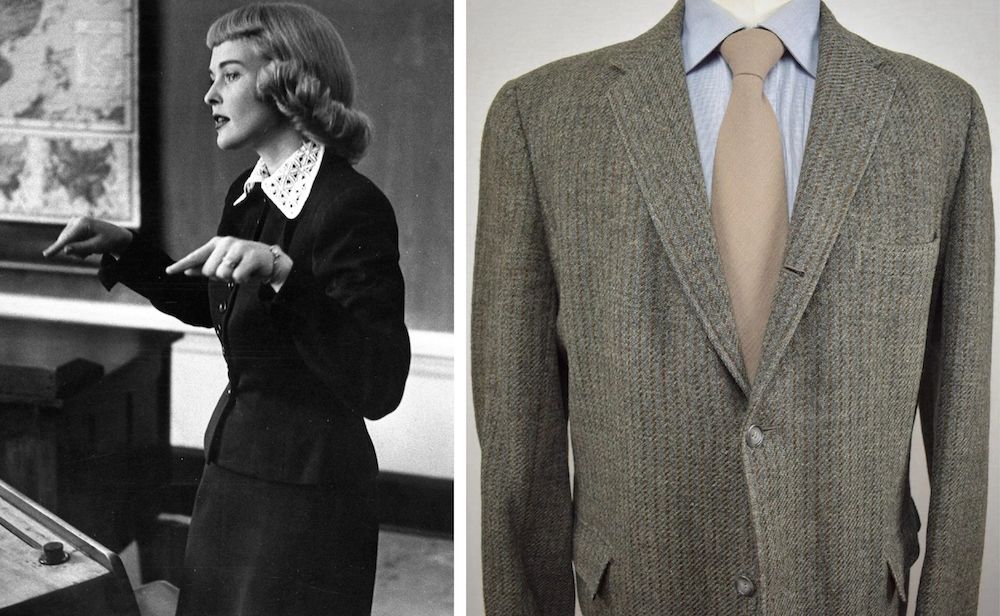
There were interesting dress codes for teachers at SJCI in the 1950s and 60s. But there was also a discriminatory element built into the norms of the day. While there was no dress code, certain standards were presumed, or, in the case of female teachers, required.
Male teachers were ‘expected’ to wear trousers, shirts, ties, and jackets. Suits were also quite acceptable. Jeans and golf wear were not considerable acceptable attire. When I received my contract for St. James Collegiate, I headed downtown to one of the many men’s stores. Yes, there was Eaton’s and The Bay, but for dress clothes, I went to Thompson & Pope, known as The Man’s Shop and Long’s Men Store (where Portage Place now stands). I purchased a suit and a pair of dress pants with a jacket. For shirts and ties, I would turn to one of the big department stores.
No matter how hot the Collegiate was in the summer, in the days before air conditioning, the male teachers maintained decorum in shirt and tie.
For certain subjects, such as Phys-Ed, teachers could wear shorts and uniforms; that would continue to expand when vocational courses were added to the curriculum.
For female teachers, things were a little stricter. They were required to wear dresses, or skirts, blouses suit jackets and pumps or high heels. They could not wear pant suits or trousers. Eventually, the unwritten rules changed, and women were allowed to wear pant suits and, eventually, pants and tops without jackets and flat shoes.
For some purists, it was important that teachers did not look like students. As one teacher said, ‘students need role models, not friends. They have lots of the latter, but fewer of the former.’
… with memories form the MB Historical Society, Dorothy Young, former Vice Principal, and Mr. D. ff.
Staff Rooms
When the original building was constructed in the 1950s, the staff lounges were located in the “cubby holes” on the stairwells. They were functional enough in the school’s early days. Some had tea kettles, some toasters, some toaster ovens and even small fridges.
However, as the Collegiate grew so did the need for more staff ‘lounges’. Two new staff rooms were added in the 1960s, across what most will remember as Jimmies’ Junction. The two staff rooms, one male and one female, were divided by a smaller room with a sink and a toilet (EWW). Many of the senior female staff members maintained their lunch areas in the tower rooms. Most of the male teachers crowded into their staff room. And it was crowded! One wall had a large heavy chesterfield while the center of the room was occupied by a bridge table and chairs. With four of the guys playing bridge. There was not much room for a comfortable lunch. Arrive late for lunch and your seat became the end of the chesterfield. Incidentally, teachers were still smoking in the staff rooms.
With more expansion, a staff room for both males and females was created at the end of the west wing. However, the Fire of ’85 badly damaged that area. In the aftermath, Vice Principal Dorothy Young oversaw, not only an expanded student cafeteria but also a larger staff room. Freshly painted, the room had comfortable chairs and round tables, a carpeted facility and access to the cafeteria via an order window. And she declared the room Non- Smoking!
One of the notable features of the SJCI Staff Room was its welcoming to all - student teachers, guests, educational assistants and substitutes. In some other high schools, practice teachers were not allowed to use the staff room because they were not yet teachers! And, in some of those schools, teachers had designated chairs and tables for themselves and their colleagues.
Our new staff room was an important factor in removing gender barriers and creating a strong collegiality among all members of the staff.
SJCI Principals
1951–1965: Victor Glen Clark
1965–1966: Ronald MacIntosh
1966–1975: Laurence “Larry” Friesen
1975–1978: Dennis Stefanson
1978–1981: Laurence “Larry” Friesen
1981–1985: John Proudfoot
1985–1987: Roger Cathcart
1987–1990: Christopher O'Grady
1990–1991: Wallace “Wally” Linton
1991–1995: Gordon “Gord” Tovell
1995–1998: L. Glen Bennett
1998–2005: Gregory Mutter
2005–2012: Dawn Hicks
2012–2015: Kevin Dueck
2015–2024: Lorelei Steffler
2024–2025 (Dec 31): Kyle Lizotte
2026 (Jan 1) to present Roné Boyko
V.G. Clark, was the first principal of the newly constructed St. James Collegiate. Born in the tiny village of Miller City, Ohio in 1900, he came to Manitoba as a child. He received degrees in Arts from Brandon College (1921) and Science from the University of Manitoba (1926) and began teaching in 1929, first in Dauphin and Melville, Saskatchewan before coming to St. James where he became the first Principal of St. James Collegiate. He retired in 1965 and died at Winnipeg in 1982.
Larry Friesen was the longest serving principal -for twelve years. Born in Gretna in 1927, he moved to Winnipeg to pursue his education, earning his B.A., B.Ed., and M.Ed. from the University of Manitoba.
He was a teacher at The Collegiate in the fifties and served as Vice-Principal from 1963-1965. He then began a long career of various principalships with two different times at SJCI. He passed away in Winnipeg in 2024.
Thanks to MB Historical Society, Dorothy Young, SJCI Vice Principal, Winnipeg Free Press Obituaries
Dress Code at St. James Collegiate The Early Years (Student Style)
The 1950s and 1960s dress code at St. James Collegiate followed the strict, traditional rules typical of the St. James-Assiniboia School Division, and of most city school divisions, during that period. These rules reflecting the cultural standard of the era required modesty and neatness.
Girls were strictly required to wear dresses or skirts. Pants or slacks were explicitly banned for classroom wear. However, during Winnipeg winters, girls were permitted to wear pants under their skirts for the walk to school. However, they had to remove them immediately upon entering the building and store them in their lockers. Hemlines were strictly monitored. Skirts typically had to touch the floor or a certain point while kneeling. Yes, hemlines were indeed tested! ‘Miscreants’ were suspended!
Boys were required to wear formal trousers or slacks paired with neat, button-down collared shirts. Blue jeans, t-shirts, and casual sportswear were banned from daily classes. In the mid-to-late 1960s, another point of tension was hair length. Boys were subject to the "collar test"—hair could not reach the shirt collar or cover the ears. Facial hair was also a no-no.
As the decade progressed, a ‘clash’ emerged between the strict regulations enforced by school administrators and the evolving youth fashion trends like the mini-skirt and longer hair.
During the late 1960s, school boards across Winnipeg routinely sent warnings home to parents regarding non-compliance with the dress and hair policies. The enforcement began to relax gradually by the early 1970s in St. James high schools as student councils at Silver Heights and St. James Collegiate pushed for changes.
While it did not always result in a single, massive, singular strike, the "protest" in St. James evolved as an ongoing, highly organized battle of civil disobedience, petitions, and student council lobbying.
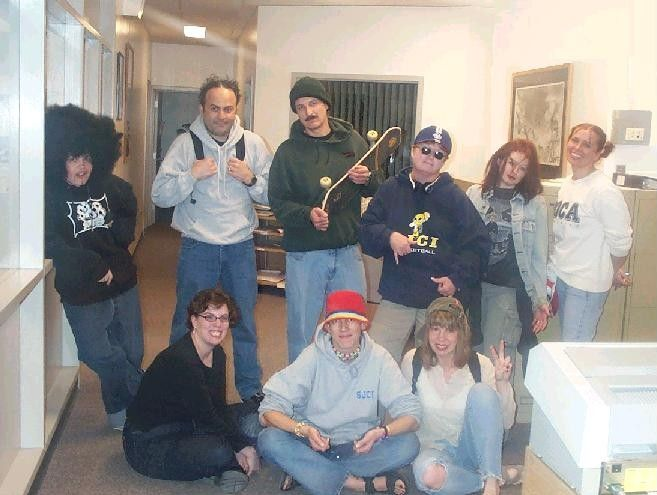
The most coordinated protests involved female students organizing collective "pants days". Girls would coordinate via whispers in the hallways to all show up on a specific Friday wearing slacks or jeans instead of skirts. If an individual girl wore pants, she was sent home; if half the school did it, the administration faced a logistical gridlock.
However, despite his traditional background, records and student accounts show that Mr. Friesen, who had become Principal in 1966, and the St. James school officials handled the student pushback with reasonable judgment rather than a heavy hand. They recognized the cultural shift was a losing battle for the old guard.
Thanks to Facebook writers and the MB Historical Society, Ms. Young and Mr. D
SJCI 1951 to 1969: The Growing Years
Before the construction of SJC I the property had been the Bourkevale Golf Course but before any construction, the taxpayers had to approve a tax increase for its construction. Yes, in those days, property owners voted on expenditures in binding referenda; the measure passed and the province provided additional funding.
Construction began in the winter of 1951 and was only partially completed for September school opening with the formal opening in January 1952. The cost for the original twenty-one room building - $355,000!
As the school population grew so too did the building - an annex was added in 1954, a new gym in 1958, a vocational wing in 1963 and a theatre in 1966.
By the late 1960s there were over one thousand students from grades 10-12. Mr. Friesen was the principal, and he had replaced Mr. Macintosh (1965-66) who had replaced the original principal Mr. V. G. Clark (1951-65).
Mr. Friesen had to timetable the entire school by hand.
The school day began at 9:00 AM with O Canada, the Lord’s Prayer, and a Bible reading. Morning classes ended at noon and re commenced at 1:15. The school ended with the playing of God Save The Queen. There were seven class periods each day and each class ran for the entire year. There was no semester system. Failure in any class meant repeating the class next year or night school.
Meanwhile, back in the hallways there was so much student traffic that congestion by the main office was inevitable the Easter will be came the up and the West became the down student lockers, with only one visit per half day we're located affectionately in the basement area known as the pits there was one locker room for the guys and one for the girls teachers had to do regular checks of the locker areas we were told to make lots of noise as we descended the stairs just in case there happened be some smoking going on.
…Memories of a New Teacher
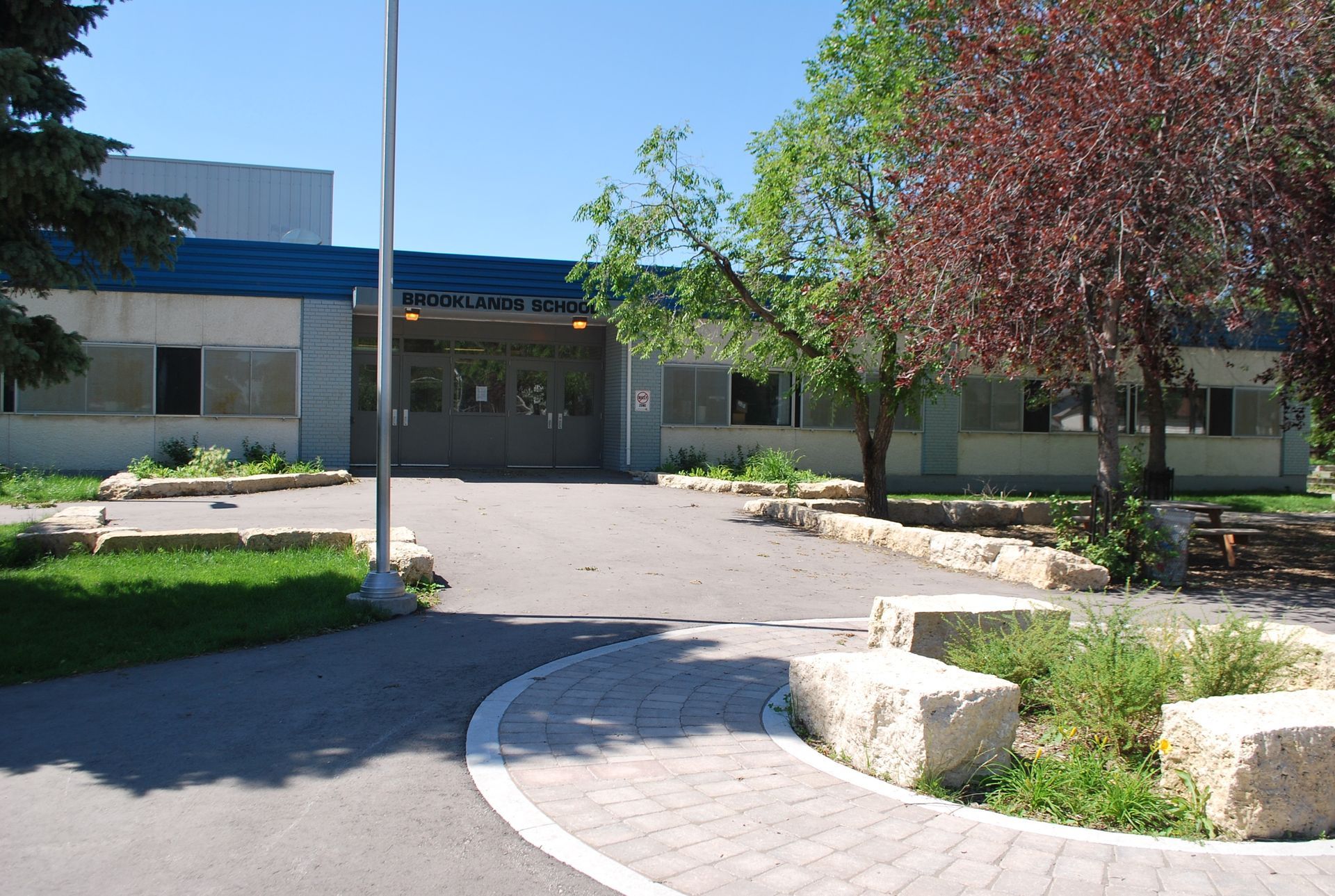
Brooklands Book and Breakfast
For more than two decades, SJCI’s Brooklands students have returned home to Brooklands Elementary School for a special day celebrating I Love to Read Month.
In the fall of 2003, SJCI Student Council brainstormed ideas to celebrate I Love To Read Month in February, but, in the process, how to engage young readers. Council, led by several Brooklands students on Council, came up with a special day plan. To get the ball rolling, we applied to the Winnipeg Foundation for a Youth in Philanthropy grant. It started off with getting a book into the hands of every pupil. But soon, it evolved into reading mentorship and nutritious breakfast.
We contacted the principal and reading clinicians at Brooklands Elementary so that we could determine the reading level and interests of each of the elementary kids. The SCJI students then scoured the book catalogs for those books and, with the grant money, ordered enough books for each Brooklands pupil plus extras for the school library. Once the books arrived our crew divided the books into classroomi and assigned a book to each pupil based on the criteria of interest and reading level. Each book was tagged with a name. Our planning crew wanted to do more and make the whole morning a memorable one, by reading stories and catering a nutritious breakfast. Melissa Pommer, who was in Grade 11 in 2006, was in on the project from its inception in 2003. She said she never had big kids reaching out to her when she was a little kid at Brooklands “We had to change that. If we make one kid happy, we’re happy with what we’ve done.” Richard Chiang, another one of our students, said “It’s important to get more young people involved in literacy.”
Grade 4 pupil Kaela said she had been looking to the big day all year long. “We like listening to them, because they pick the top books that our school likes”.
Our Big Day came in the winter of 2004. SJCI students from the Brooklands area hustled to Brooklands Elementary to fire up the griddles and set out the supplies. As the youngsters arrived, they were treated, buffet style, to pancakes and syrup, fruit juice and fresh fruit. Anyone for seconds? Some of the guys one would least expect carried the plates and helped the little ones to their seats, cut their pancakes and even served seconds!
Once breakfast was over the little ones returned to their classrooms where, once again, those ‘guys’ jostled for the opportunity to read stories to the kids. Meanwhile, others cleaned up the breakfast area and got the gym ready for the presentations.
Then, it was curtain time! All the little ones came back to the gym from their reading rooms and sat in their classroom groups. At the front of the gym, our students lined up and called each Brooklands pupil up by name and handed them their special book. The excitement was infectious; the morning was truly rewarding.
Each year, the program grew in popularity, more SJCI students became involved. Now, more than 20 years later, SJCI students are still ‘bringing literacy back home’.
– with articles from Nick Martin, Sam Thompson and fond memories from Mr. D
St. James Collegiate Football:
1959, The Inaugural Year
George Moore, the Phys Ed Supervisor for the Division, was the real spearhead in getting football for the Jimmies, but we couldn't play in the Winnipeg High School Football League in that first season of 1959-60. It was a closed shop. I suspect more the reason was that we might be too competitive. SJCI at the time had one of the biggest student populations.
Barry Roseborough (d.1992) was chosen to be the first coach (also taught Phys ed 1959-60). He was a Winnipegger who had been the backup QB for the Bombers. The other coaches were George Moore and Ron ‘Pepe’ Latourelle, also a Bomber (1955-64) at the time. There were also some unofficial coaches -- members of the Blue Bombers, some of them Hall of Fame players too. (At that time, the Bombers played out of the Winnipeg Stadium, located just north of Polo Park Shopping Center.)
The Jimmies were loaded with talent and size. The first game was a mini-game of one 15 minute quarter of what was an annual charity event held at the Stadium. SJCI opened against Sisler and “we beat them up pretty well in that 15 minutes. Apparently the Sisler coach was speechless that we would be that good”.
The first full game was against Gordon Bell at our field. The Jimmies won most of the games we played which included one against a team from Landmark MB. Since SJCI was locked out of the WHSFL, the Jimmies played whomever they could.
There were some very good players that year, some of whom went on to college careers -- Gord Irwin, Len Mackling, and Gord Brown who was the most successful. He got a full ride to the University of Oklahoma Sooners, was the last cut of the NFL St. Louis Rams, and then played several years with the Bombers. Giant tackle Ross Headon eventually made it to the Bombers as well.
-Thanks to Maurice Hogue
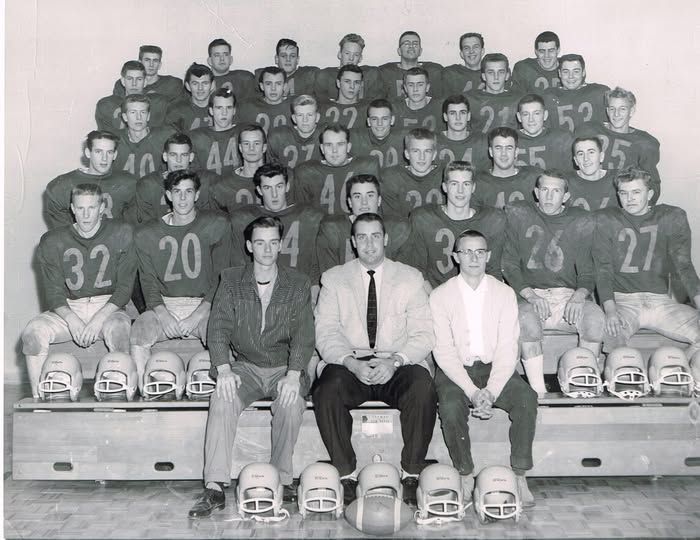
Left to right
In Front Les Burnell mgr., Coach Barry Roseborough*, Keith Potter* mgr.
First Row Gord Irvin, Rich Whiting, Ron Bartlett, Bruce Cromb*, Wayne Smith, Brian Thomas*, _____
Second Row Rod McQuarrie*, _____, _____, Mike Valk, Jim Grant*, Jim Allan, Ron Leitold
Third Row Doug Smith, Gord Watson, John Harvey, Lyndon Carter, Aubrey Lytle, Neil Cooper, Lorne McCulley
Fourth Row Brian Middleton, Jim Milne, Howie McMillan*, Frank Bailey, Gord Brown*, Ed Roe, Lenny Mackling
Fifth Row Herb Cooper*, Bob Buckberrough*, Bob Millar*, Bob Butler, Moe Hogue, Roy Pakulak, Ross Headon*
Missing from picture Assistant coaches Ron Latourelle, George Moore, various members of the Winnipeg Blue Bombers
Deceased
Give It a Try* The Glory Years of the SJCI Rugby Program
St. James Collegiate had a rugby program for the first twenty-one years of school rugby play in Winnipeg.
The program was started by Phys Ed teacher Steve Cara ((1968-80). Steve knew the students in the school and thought they would be well suited to rugby. Players took to the game. The rugby program was much more cost effective than football which had been played previously.
SJCI participated in the first school rugby competition in 1973. The team was successful in the tournament. The players liked rugby and were keen to join the school rugby league when it started in 1974. St. James earned a spot in the final at the end of the first season. They lost a hard fought final to St. John’s. The nucleus of the team continued the following season. Steve’s prediction was correct and the players decided to create a senior men’s team – the St. James Zots.
The Jimmies had a number of strong players over the first twenty years. Some of the most notable were Bill Zubrack and Erik Luinenberg - both have been inducted into the Manitoba Rugby Hall of Fame. Some of the other strong players include Dave Birt, Tom Schioler, Keith Grant, Dave Feniuk, Vince Runchey and Jeff Ward. Vince returned after graduation to give several years service to SJCI as a coach.
Of note, during the second last season of 1993, SJCI was victorious as second division winners.
SJCI was fortunate to have three teachers lead the program. Steve Cara started the program. When Steve moved to John Taylor, Mark Carlow(1980-90) took over the program. In 1984, Jim Feasby (1984-1997) assumed leadership and led the program until 1994. Jim has been inducted into the Manitoba Rugby Hall of Fame as a builder – making three Jimmies who have been inducted.
* Scoring in rugby is called a ‘try’
The Fire of '85 (Part 1)
It was the spring of 1985 one late evening Vice Principal Dorothy Young received a call from the police that there was a fire at The Collegiate, and she had to get to the school immediately. The fire inspector said that the fire has started in the marketing teacher's office and then quickly spread to the adjacent classroom and then south along the west to the staff room and
cafeteria. While contained to those areas, the smoke damage was extensive throughout the complex.
Quickly, Ms. Young phoned all the teachers and had teachers phone their students that classes were cancelled that day (you have to remember this was pre-email and pre-cell phone) She also had to make arrangements to open up the recently mothballed Deer Lodge Junior High and then create a hand timetable (again, this is pre computer and pre AI) for all of the students from grades 7 to 12; yes, at that time, SJC I was a 7 to 12 school.
But Deer Lodge wasn't big enough for all the students. Necessity being the mother of invention Ms. Young created a timetable for staggered hours. Grade 10-12 students attended in the morning and the 7 to 9 students in the afternoon. In that way the older students could easily make their part time jobs and the younger students got to sleep in. There were a few teachers - I was one of them who taught at both levels at SJCI and wound up teaching the entire day basically from 7:00 am until 5:00pm.
It was a remarkable accomplishment. We hardly missed a beat thanks to the herculean efforts of Ms. Young, the teachers, maintenance crews from SJC I and the Division and, yes, the students-we made it work!
(with recollections from Ms. Young and Mr. D.)
To Be Continued…
SJCI and Legion #4 (Part 1)
St James Collegiate and The Royal Canadian Legion #4 have had a significant relationship for over 75 years. Many of the World War II veterans’ children attended SJC I so it was a natural relationship.
The members of the Legion were ordinary Canadians who made extraordinary sacrifices. Each year, members of the Legion and the Ladies Auxiliary attended our Undergrad and Grad ceremonies bringing bursary and scholarship money with them.
In turn, SJC I honored the veterans’ wartime sacrifice and support in a variety of ways. Mrs. Phillips and her art students painted a full wall mural in the front foyer by Room 1. On that wall, we hung two large, framed plaques with the names of the veterans from the St. James area. Those who paid the supreme sacrifice had a Gold Star affixed beside their name. Several years later, Ms. Bachewich and her art students gave the mural a fresh coat of paint.
Our students assembled in the gym each November to honour our veterans with poetry read and hymns sung by students and the plaintiff music of one of our student or staff pipers. Perhaps, it was Mr. Workman who played reveille on the trumpet Mr. D would give a speech highlighting a wartime anniversary. In 1994, he spoke of the 50th Anniversary of D-Day, in 2001 of the 60th year of the Battle of Hong Kong, in 2004 the death of our young men in faraway places. At the end of the assembly, our Student Council President accompanied an honoured veteran guest to lay a wreath at our Memorial Wall.
Over the years, that mural was a stopping point for visitors to the school. For the students, it was one way of saying….
“To our veterans past and present, Thank you for this freedom. Thank you for this great country. Thank you, from this grateful country.”
To Be Continued…
Jimmie's Gyms
“Which gym do you remember?”
“Do you mean there was more than one?”
“ Yes - three in fact!”
When SJCI opened in 1951-52, it sported a gym that served multiple purposes. Of course, it was a sports venue for practices and interschool games. But, with a growing student population, a second gym was added in the 60s; the original gym would serve new roles.
Remember the magnificent Broadway style productions produced by Mr. Gardner – “A Funny Thing Happened on the Way to the Forum”, “The Music Man” and “How To Succeed in Business”? During the school day it became a supervised study hall. Were you one who skipped out to “study” across the street at The Avenue”?
That gym also had a couple of firsts. Bob MacGregor created the first radio station in a St. James Division school. He and his crew spun tunes on a hi-fi that played throughout what had now become a student lounge.
Student Council inaugurated the first student cafeteria there. Student Councillors hustled down before noon to start up the fry pans for perogies, grilled cheese, and to set out home baking desserts from Tom’s mother. Later Mr. Kaleta and the business department students operated it.
Today that area is the Autobody Shop and Mr. Skryba was the instructor for over twenty years.
What are your memories of the ‘Old Gym’?